



Bitcoin traded at $59,048 at 08:09 UTC on November 22, up 2.4% in 24 hours and 7.7% lower over seven days, according to CoinGecko . Ten days ago the same quote was $71,372. The seven-day low of $55,711, printed at 06:00 UTC on November 21, is the number that emptied leveraged accounts over the weekend.
The number that matters for anyone weighing what to buy is a different one: $56,041, the modelled cost of producing a single bitcoin on 20 joules-per-terahash hardware running at five cents a kilowatt-hour, at the network’s current hashrate and block subsidy. At $59,048 the market pays about $3,000 above that line. Every rig with worse silicon, or with a power contract above roughly 5.3 cents, is currently producing coins at a loss.
That figure is a calculation rather than a quotation, and the method is set out below so it can be checked line by line against mempool.space and CoinGecko. The timing around it belongs to the Federal Reserve, which meets on December 8 and 9 with a fresh Summary of Economic Projections, three weeks after two governors voted to raise rates at a meeting the Committee held steady.
What $10,000 Buys at $59,048
Prices below are CoinGecko quotes taken at 08:09 UTC on November 22. The final column is the multiple each asset needs to reach bitcoin’s $1.188 trillion market value, which is the only honest way to compare a $59,000 coin with a $0.92 one.
| Asset | Price | 24h | 7d | Market cap | Multiple to BTC cap |
|---|---|---|---|---|---|
| Bitcoin (BTC) | $59,048 | +2.4% | -7.7% | $1.188T | 1.0x |
| Ethereum (ETH) | $1,666.55 | +2.6% | -6.5% | $203.7B | 5.8x |
| XRP | $0.9152 | +3.0% | -4.6% | $58.1B | 20.4x |
| Solana (SOL) | $69.16 | +3.2% | -1.9% | $40.9B | 29.0x |
| Zcash (ZEC) | $786.24 | +8.5% | -12.0% | $13.4B | 88.6x |
| Bitcoin Cash (BCH) | $194.69 | +4.3% | -4.6% | $3.9B | 304.6x |
A $10,000 ticket buys 0.1694 BTC, 6.00 ETH, 144.6 SOL, 10,927 XRP, 12.72 ZEC or 51.36 BCH at these prices. Ether is the only one of the five alternatives holding more than a tenth of bitcoin’s value, at 17.1%. Zcash holds 1.1%. The multiple column says what the smaller asset has to do to close the gap, and none of them closes it through adoption alone inside a single cycle.
The relative moves are worth reading against Bitcoin’s own tape. Every asset in the table is higher over 24 hours and lower over seven days, which is the signature of a bounce inside a drawdown rather than a rotation. Zcash and Bitcoin Cash led the bounce, and both are the smallest names in the group, which is what happens when short positions pay to close.
Hashprice: $25.36 per PH/s per Day
Bitcoin pays miners 3.125 BTC per block, 450 BTC across 144 blocks a day. Fees added about 1.4 BTC a day over the last 15 blocks, at a median fee rate near one satoshi per virtual byte, so gross miner revenue runs at roughly 451.36 BTC. Multiply by $59,048 and the network earns about $26.65 million a day. Divide by mempool.space’s current hashrate estimate of 1,050,763 PH/s and the result is $25.36 per petahash per second per day. That is the industry’s hashprice.
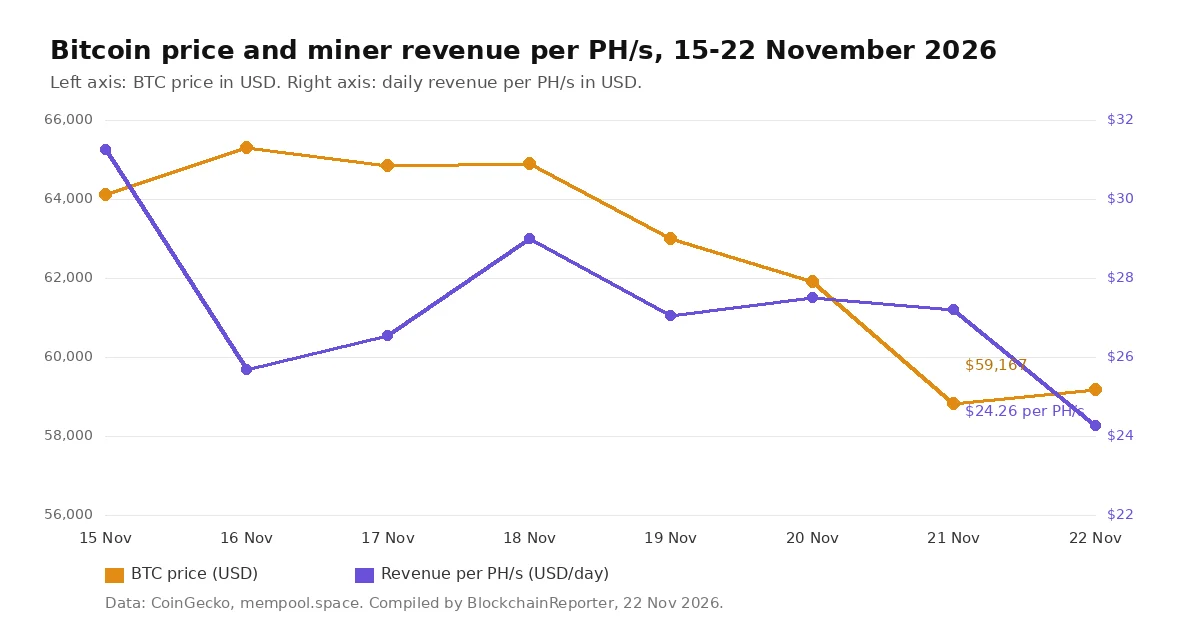
Six days earlier the same arithmetic produced $31.26. Bitcoin was $64,120 on November 15 and the daily hashrate average was 925.8 EH/s, so revenue per unit of compute was 18.9% higher than it is now. Revenue fell 18.9%. The margin did something more violent.
Take a 20 J/TH machine on five-cent power: 480 kilowatt-hours a day per petahash, or $24 of electricity. At $31.26 of revenue the operator kept $7.26 per PH/s per day. At $25.36 the operator keeps $1.36. Revenue fell by a fifth; the margin fell by 81%. That gap is the reason miner equities have moved more than bitcoin this month, and it is why the cost line matters more than the drawdown.
What One Bitcoin Costs to Make
The cost table below divides the network’s total daily electricity bill by the 450 coins it issues. Each row is a hardware efficiency class; each column is a power price. The hashrate is held at the current 1,050,763 PH/s and bitcoin at $59,048, so the figures move with both.
| Rig efficiency | At $0.04/kWh | At $0.05/kWh | At $0.06/kWh |
|---|---|---|---|
| 17.5 J/TH | $39,228 | $49,036 | $58,843 |
| 20 J/TH | $44,833 | $56,041 | $67,249 |
| 25 J/TH | $56,041 | $70,051 | $84,061 |
| 30 J/TH | $67,249 | $84,061 | $100,873 |
Read it as a map of who survives. At $59,048 a 17.5 J/TH fleet stays profitable with power as expensive as six cents, a 20 J/TH fleet breaks even at 5.3 cents, a 25 J/TH fleet needs 4.2 cents and a 30 J/TH fleet needs 3.5 cents. The newest air-cooled machines sit in the 14 to 17 J/TH band, so a well-run operator with cheap power is still earning. The older installed base is not, and the public mining companies that report fleet averages above 20 J/TH are producing at a loss at today’s price.
Three costs are excluded: capital repayment on the machines, cooling overhead, and pool fees of roughly 1% to 2%. Add them and the effective line moves up by several thousand dollars a coin. The model is a floor, not a full income statement.
Difficulty Adds 9.4% on November 27
The network adjusts difficulty every 2,016 blocks. mempool.space projects the next adjustment at block 977,760, 736 blocks from publication, on November 27, and puts the change at plus 9.4%. If bitcoin’s price is unchanged when it lands, the same revenue gets divided by more work and hashprice falls to $23.19, another 8.6% lower.
The previous adjustment, on November 15, cut difficulty by 9.13% — which is why revenue per PH/s held up better than the price did that week. The two adjustments in sequence show the lag: difficulty follows hashrate, hashrate follows capital decisions that were made months ago, and the price moves first. Miners cannot cut their way out of a price fall inside one adjustment window; they can only switch off the least efficient machines and wait for the next retarget to reflect it.
Daily hashrate averages are also noisy. mempool.space’s daily series swung from 925.8 EH/s on November 15 to 1,147.5 on November 16 and back to 1,100.8 on November 22, which is block-luck as much as capacity. The three-day average it publishes, near 1,050 EH/s, is the more stable input, and it is the one used above.
December 8-9 Is the Actual Test
The Federal Reserve left the target range at 3.75% to 4% on October 28 by a 10-2 vote. The statement recorded that “Voting against the monetary policy action were Lisa D. Cook and Beth M. Hammack, who preferred to raise the target range for the federal funds rate by 1/4 percentage point at this meeting.” Two dissents in the direction of tighter policy, with inflation described as still elevated, set the tone for the year’s last meeting.
The minutes published on November 18 went further on the supply side. “The vast majority saw upside risks to this outlook, citing higher energy prices and continued supply constraints with regard to refined fuel products,” they read, and “Many participants viewed the AI buildout as a material source of inflation risk.” Energy prices and data-centre construction are the two inputs that matter most to a bitcoin miner’s income statement and to the discount rate applied to a non-cash-flow asset.
The December 8-9 meeting carries a Summary of Economic Projections, so it resets the projected path rather than only the overnight rate. That is the event that decides whether a marginal producer’s cost line is financed at 4% or at 5%, and whether the market is willing to pay a premium to production cost at all. A cost floor is a slow variable. The policy rate is the fast one.
The Asset to Watch: Zcash at 1.1% of Bitcoin
Zcash is the only name in the table with a corporate catalyst inside the last week. Fortitude, the Nasdaq-listed Zcash miner, cleared its shareholder vote on the merger that takes it toward a TUDE listing, as BlockchainReporter reported on November 21. ZEC traded at $786.24 at 08:09 UTC, up 8.5% in 24 hours, down 12.0% over seven days and down 37.8% over fourteen.
The valuation is the argument and the warning at once. At a $13.4 billion market cap Zcash is 1.1% of bitcoin’s value, and it would need to rise 88.6 times to match it. It is still 75.4% below the $3,191.93 record it set in October 2016, and it is up 53% over twelve months while bitcoin is down 30%. That combination — a strong year inside a violent two-week drawdown — is what a crowded privacy trade looks like when the funding cost rises.
What Would Change This Answer
Three observable things would move bitcoin off the cost floor. A price above roughly $67,000 restores a positive margin to a 25 J/TH fleet at five-cent power, which is most of the listed hashrate. A difficulty cut larger than 10% at a future retarget would lift hashprice by about 11% with the price unchanged. A December projection set that prices fewer hikes would lower the discount rate applied to every non-yielding asset in the table.
One structural number deserves attention regardless. Fees contributed about 1.4 BTC of the 451.36 BTC miners earned per day, or 0.3% of revenue, at a one-satoshi fee rate. A network that pays for its security almost entirely from issuance is a network whose production cost is set by the subsidy schedule, and the next halving in 2028 cuts that subsidy in half. The cost floor is not a fixed feature of the market. It is a moving one, and it moves against the miners.
Data: CoinGecko , mempool.space , Federal Reserve .
Frequently Asked Questions
There is no single answer, and this article does not give investment advice. What the data supports is a comparison: bitcoin trades about $3,000 above its modelled production cost at 20 J/TH and five-cent power, ether holds 17.1% of bitcoin’s market value, and Zcash holds 1.1%. Each requires a different thesis, and the December 8-9 Federal Reserve meeting resets the discount rate for all of them.
It depends on the rig and the power contract. At 20 J/TH and five cents a kilowatt-hour the modelled cost of one bitcoin is $56,041, below the $59,048 price. At 25 J/TH and five cents it is $70,051, and at 20 J/TH and six cents it is $67,249. Efficient fleets are profitable and older fleets are not.
Hashprice is the revenue a miner earns per unit of hashrate per day. It combines the block subsidy, transaction fees and the bitcoin price, then divides by network hashrate. On November 22, 2026 it stood at $25.36 per PH/s per day, down from $31.26 on November 15.
mempool.space projects the next retarget at block 977,760, around November 27, 2026, with an estimated increase of 9.4%. The previous adjustment on November 15 cut difficulty by 9.13%.
Margins compress twice: once from the price and again from the difficulty increase on November 27. Operators with power above roughly 4 to 5 cents a kilowatt-hour, depending on machine efficiency, produce at a loss and typically curtail. Difficulty only reflects those shutdowns at the following retarget, so the adjustment lags the decision by weeks.
This article is for informational purposes only and does not constitute financial, investment or trading advice. Readers should verify figures independently and consider their own circumstances before making any decision.
This article is not intended as financial advice. Educational purposes only.
The post Best Crypto to Buy Now: Bitcoin at $59K Sits Just Above Its Cost of Production appeared first on BlockchainReporter .