



MoonPay’s outside counsel sent the Office of the Comptroller of the Currency an application on Nov. 17 to organize MoonPay National Trust Bank. The OCC logged it on Nov. 18 and placed it on the public table of pending digital-asset licensing applications . The bank would sit at 407 Lincoln Road in Miami Beach, Florida, be owned outright by MoonPay Inc of 520 Broadway in New York, and be limited to trust-company work.
The calendar is the part worth reading twice. The filing arrived 62 days before the GENIUS Act and the OCC’s implementing rule take effect on Jan. 18, 2027 . That law puts payment stablecoin issuers inside a federal permission system, and the OCC has not yet opened the window for those issuer applications. MoonPay is not applying as a stablecoin issuer. It is applying to own a bank that would issue stablecoins.
What the bank would be allowed to do
The application states the scope in one sentence: “Once chartered, MNTB will provide (i) fiduciary custody services; (ii) stablecoin services, including stablecoin issuance, redemption and reserve management; and (iii) conversion services as agent.”
Those three lines are separate businesses stacked into one charter. Fiduciary custody means holding client assets under a legal duty, not merely in a vault with a login. Stablecoin issuance, redemption and reserve management is the mint-and-burn side of the market, plus the balance sheet that stands behind every token. Conversion as agent is the plumbing between fiat and tokens, done for a customer rather than as principal.
The vehicle is a “non-depository national bank … the operations of which will be limited to those of a trust company and activities related thereto,” per the same filing. The organizers asked for full fiduciary powers through the business plan, as permitted under 12 C.F.R. § 5.20(h)(7), rather than through a separate trust-powers application.
Two details in the application make the intended shape clearer than the marketing language. “The organizers have no plans for MNTB to establish branches or to relocate its main office within the de novo period,” the filing says, and “MNTB will serve clients through digital channels and the office will not be open to the public.” This is a licensed entity built for business customers, with a street address that exists mainly to satisfy chartering rules.
Where the public file goes quiet
Volume A of the submission carries three exhibits: the interagency charter application, a form of oath for the directors, and a form of public notice. Volume B carries 12: the business plan, financial projections and assumptions, a permissibility analysis, a citizenship waiver request, a residency waiver request, a stock certificate form, articles of association, bylaws, biographical and financial reports, a response to question 2(f), a stock benefit plan, and the lease for the Miami office.
Twelve of the 15 exhibits, or 80%, are withheld from the public file. MoonPay’s counsel, Sullivan & Cromwell, asked the OCC to keep them confidential under the commercial-information exemption in the Freedom of Information Act, arguing that release would “publicize confidential plans for how the Bank intends to structure and run its business, resulting in a loss of competitive position.”
So the record shows who is behind the bank, where it would sit, which powers it wants and which waiver it needs. It does not show the capital, the headcount, the revenue model, the launch budget or the reserve design. A reader can see the skeleton and not the balance sheet, and the OCC’s review will happen on the part that is not public.
The public still has a formal channel. The notice to be published in the Miami Herald says: “Any person desiring to comment on this application may do so by submitting written comments within 30 days following the date of publication of this notice” to the Director for Licensing, Trust Banks, in Washington, or by email to LicensingPublicComments@occ.treas.gov. If that notice ran within days of the Nov. 17 filing, as the form envisages, the comment window closes around the middle of December, roughly a month before the stablecoin law takes effect.
A board that needs the OCC to waive its own rules
The application also asks the regulator to relax a rule about who may sit on the board of a national bank: “Pursuant to 12 C.F.R. § 5.43, MNTB respectfully requests a waiver of the citizenship and director residency requirements set forth in 12 U.S.C. § 72.”
The public notice explains why. The organizers are Ivan Soto Wright of Miami, Victor Faramond of Bordeaux, France, Caroline Butler of New Canaan, Connecticut, Michael Lempres of Atherton, California, and Anne Giviskos of Rye, New York. One organizer lives in another country, and the National Bank Act’s director provisions assume otherwise, so the filing asks for relief instead of reshuffling the board.
There is precedent, and it was granted in April. The OCC’s decision letter approving Coinbase National Trust Company states in a footnote: “The OCC also grants the request to waive the director residency requirement for four directors.” That approval was preliminary and conditional, which is the normal first step for a de novo charter.
The proposed board has five seats: Soto-Wright as chair and interim president and chief executive, Faramond, Lempres and Butler, plus a fifth director “to be determined.” Lempres and Butler are described as independent, so two of the five seats, 40%, would be held by directors without an executive role at the bank. Six executives are named: Soto-Wright, Giviskos as chief financial officer, Yujush Saksena as chief risk officer, Faramond as chief technology officer, Laura Astrada as general counsel, and Chris Gregor as chief operating officer and head of custody.
Fifteen applications in nine months
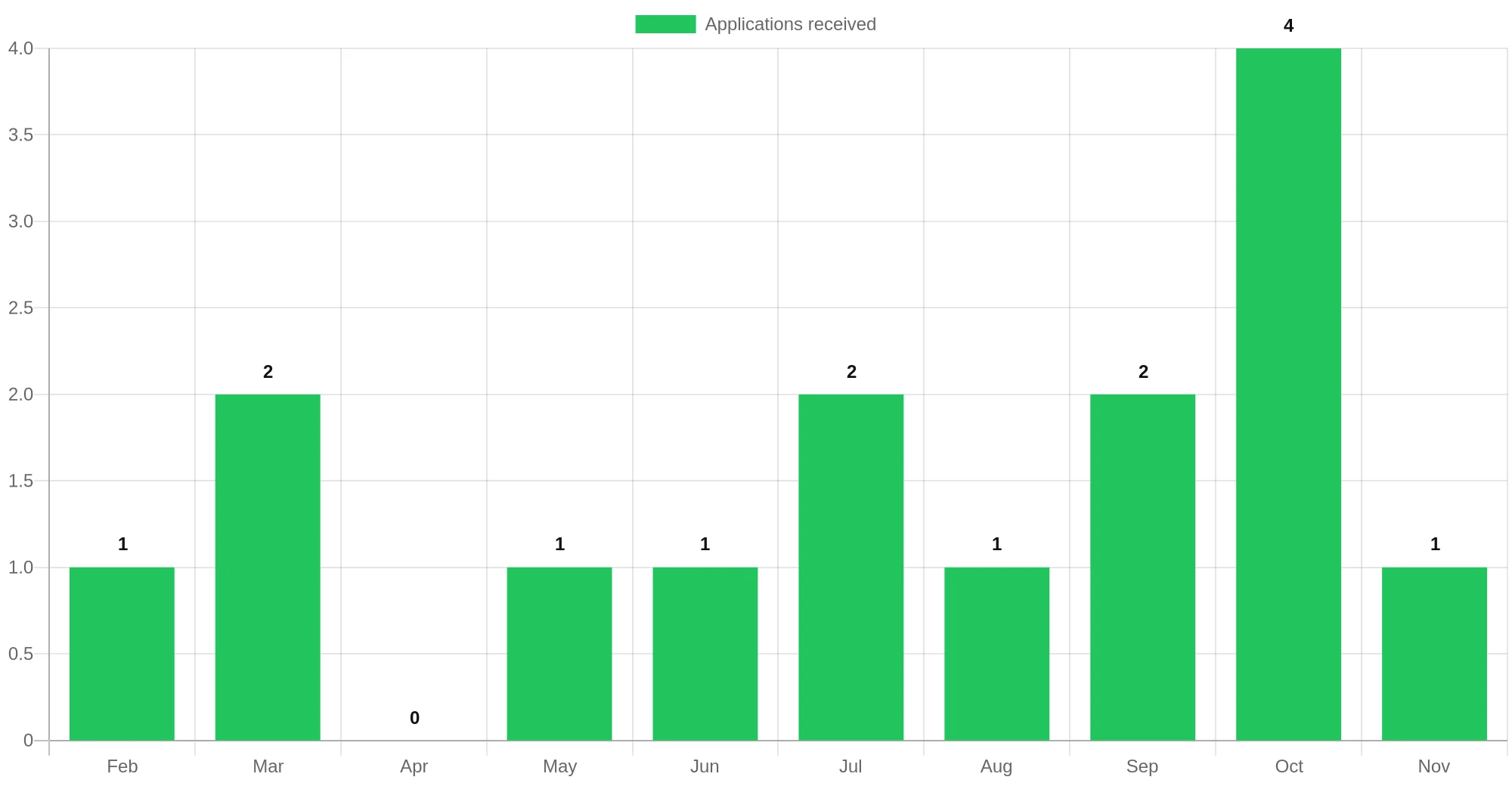
MoonPay’s row is the newest of 15 on the OCC’s table, which runs from PAYO Digital Bank on Feb. 23 to MoonPay on Nov. 18. The queue is not evenly spread. October alone produced four filings: Modern Treasury National Trust Bank on Oct. 1, Rain National Trust Bank on Oct. 5, Ramp National Trust Bank on Oct. 19 and Galaxy National Bank on Oct. 26.
Across the 268 days between the first and the latest application, the 14 gaps average 19.1 days, or about 1.7 new digital-asset charter applications a month. The table itself is only a partial count of activity inside the federal perimeter, because the OCC excludes conversions from it: “Conversion applications are not included, as they are not subject to public comment.”
Why a trust charter instead of a bank
A federal trust charter replaces a patchwork of state money-transmitter licences with one supervisor and one rulebook for custody, fiduciary duties and conversion. What it does not do is turn a payments company into a commercial bank. There is no deposit franchise to lend against and no credit book to fund, which is why these applications read like operating-company paperwork rather than bank mergers.
Stablecoin issuance under a trust charter already has a track record at the OCC. A corporate decision approving Agora National Trust Bank this year summarised the agency’s own record: “The OCC recently approved national trust bank applications for BitGo Bank & Trust N.A., Paxos National Trust Company, N.A., Bridge National Trust Bank, and World Liberty Trust Company, N.A. that included stablecoin issuance activity.”
The GENIUS layer is a second gate, not the same one. The OCC finalised its implementing rule in October, a process covered in OCC Finalizes GENIUS Act Stablecoin Rule , and the release says the agency “will announce in a separate news release when it will begin accepting and processing applications and waiver requests from prospective permitted payment stablecoin issuers.” A charter approval in the coming months would settle who supervises the institution. It would not, by itself, make that institution a permitted payment stablecoin issuer when the law switches on.
Coinbase’s charter shows how narrow the first version of these approvals can be. Its preliminary approval covered fiduciary custody and related transactional services for custody customers, with no stablecoin issuance among the listed activities, as covered in Coinbase Wins Final OCC Trust Charter . MoonPay is asking for the wider package in its first application.
The OCC frames the rule as an operating framework rather than a prohibition. Comptroller Jonathan V. Gould said in the same release: “We are providing a clear, practical framework for payment stablecoin innovation, with strong standards for reserve backing, redemption, and risk management.”
What MoonPay brings, and what the file does not say
The application’s description of the parent is short and numerical. MoonPay was founded in May 2019, has “more than 30 million customers across 180 countries” and supports “more than 500 enterprise customers spanning the crypto and fintech sectors.” It already operates inside regulated custody: the company announced a New York trust charter in November 2025, and it sells stablecoin issuance infrastructure to other companies, including minting, redemption and distribution.
That last point is the strategic logic of the filing. A company that mints tokens for other brands needs somewhere to hold reserves, a fiduciary wrapper for custody, and a single federal supervisor instead of a state-by-state map. A national trust bank supplies all three in one licence, which is why the same structure keeps appearing in the OCC queue.
What the public file will not tell you is whether the parent can carry the bank. MNTB would be wholly owned by MoonPay Inc, and the application states that “there will not be public or private offering materials,” so there is no outside capital raise to review and no prospectus to read. The capital question is a parent balance-sheet question, and the answer sits in the confidential business plan until the OCC either approves the charter or explains why it did not.
What happens next
The path runs through the comment window, then an OCC decision that in comparable cases has taken the form of a preliminary conditional approval with preopening conditions attached, then final approval before the bank may open. Nothing in the file suggests an expedited track, and the OCC’s own table lists the application as pending with no decision attached.
Two dates matter more than the rest. The comment period, on the filing’s own 30-day formula, ends around mid-December. The stablecoin law and the OCC’s rule take effect on Jan. 18, 2027. Between those two dates the OCC has to decide whether a payments company with 30 million retail customers belongs inside the federal banking system, and MoonPay has to decide what it does if the answer arrives after the stablecoin deadline rather than before it.
The public record answers the who and the what. The numbers arrive with the decision letter, or they do not arrive at all.
The post MoonPay Filed for a Federal Trust Charter. Twelve of Its Fifteen Exhibits Are Confidential appeared first on BlockchainReporter .