


Deutsche Bank has switched on digital asset custody for institutional and corporate clients in Europe after receiving approval from Germany’s Federal Financial Supervisory Authority, BaFin. The service is live with five assets: bitcoin, ether, USDC, EURC and EURAU. The bank disclosed the go-live in a November launch note on its corporate banking site.
The timing is the story. Bitcoin traded at $67,164.33 and ether at $1,906.38 at 12:31 UTC on 14 November, per Coinbase spot quotes, and futures now price roughly 64 basis points of Federal Reserve hikes over the next twelve months, up from 37 basis points earlier in the month, according to Coinbase Institutional’s 13 November weekly . A bank vault opened while the flow data ran the other way.
That contradiction is what makes the launch worth more than a press release. Custody is plumbing, and plumbing does not create a bid. But plumbing decides which institutions can hold the asset at all, and that constraint has been the missing piece in Europe for most of this cycle.
What the BaFin Approval Actually Permits
The licence scope is narrower than the announcement’s framing suggests. Access runs through Deutsche Bank’s Corporate Bank and Investment Bank client books, which the bank lists as corporates, asset managers, hedge funds, custodians, brokers and sovereign institutions. Retail is not in scope, and neither is any client outside Europe at launch.
The custody model is discretionary in the technical sense that matters: Deutsche Bank generates and holds the private keys, manages the wallets and executes transfers on the client’s behalf. “Private keys are created securely and protected using dedicated hardware,” Paul Maley, the bank’s Global Head of Trust and Securities Services, said in the launch materials.
Keys sit in separate storage environments including offline cold storage. Duties are split across staff, and material actions need multi-person approval.
That architecture is the reason the launch took two years of preparation rather than a product sprint. The bank first flagged the plan in a 16 September 2026 release that tied go-live to “the completion of the applicable regulatory timeline”. That release also warned that timing, geography and supported assets could change.
The September announcement described a service still waiting on approvals. BaFin supplied them.
The build mirrors what specialist custodians have done with hardware security modules, an approach Blockstream took this week when it moved MPC signing inside Thales HSMs to court bank custody desks . Deutsche Bank is not inventing new cryptography.
It is wrapping existing key-management practice in a banking licence, a balance sheet and a due-diligence process that institutional allocators already accept.
Five Assets In, Tokenised Securities Out
The gap between what the bank cites as the growth market and what it can actually custody today is the most useful detail in the launch.
| Supported at launch | Bitcoin, ether, USDC, EURC, EURAU |
| Client segments | Corporates, asset managers, hedge funds, custodians, brokers, sovereign institutions |
| Geography | Europe, via Corporate Bank and Investment Bank clients |
| Not yet supported | Tokenised financial instruments, additional assets pending approval |
| Regulator | BaFin (Germany) |
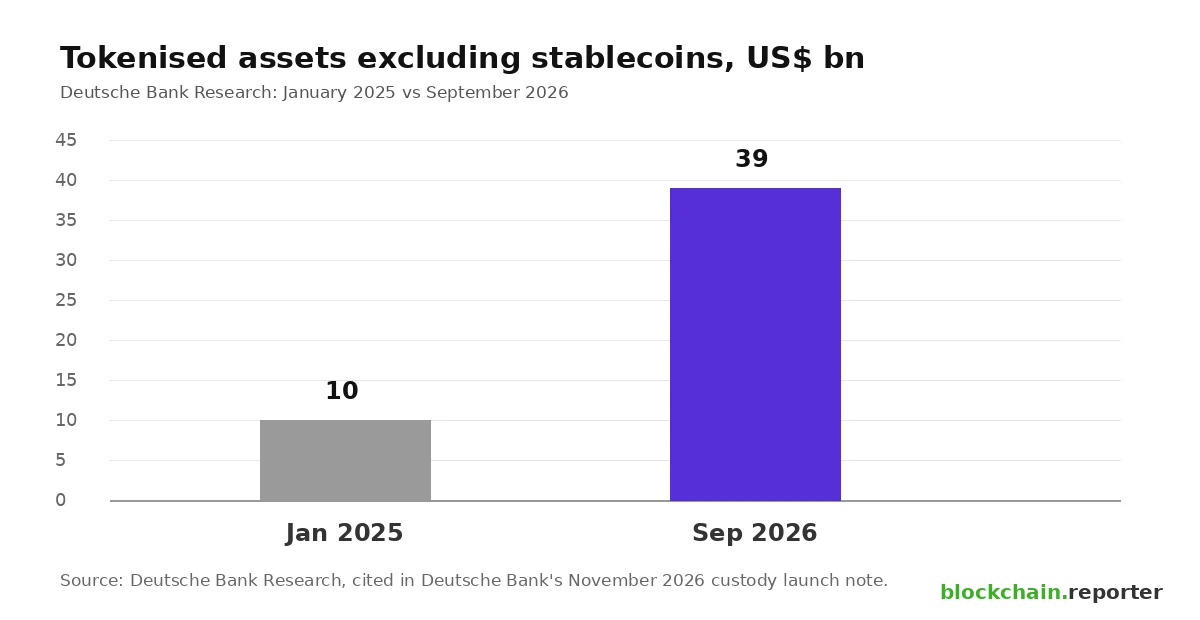
Deutsche Bank Research puts the global tokenised asset market, excluding stablecoins, at roughly $10 billion in January 2025 and $39 billion in September 2026. That is a 3.9-fold expansion, or 290%, across twenty months, a compound rate near 105% a year. It is the strongest argument in the bank’s own document for building custody now.
It is also the segment the launch cannot serve. Tokenised financial instruments are “set to be added at a later date,” per the launch note.
So the vault opens holding the assets that trade on twenty-four-hour order books, and none of the assets that generated the 290% growth the bank cites. Measured against its own research, Deutsche Bank is launching into the smaller half of the market it is pitching.
The Fee Math Behind a Bank Vault
Custody is a scale business, and the arithmetic explains both why banks want it and why they will not fight over price.
At five basis points a year, $1 billion of custodied assets throws off $500,000 in annual revenue. A single $10 billion mandate would produce $5 million. Set against Deutsche Bank’s record third-quarter post-tax profit of 1.9 billion euros, custody at launch scale is a rounding error; at institutional scale it is a franchise.
The bank has not disclosed a fee schedule, a minimum mandate size or any target for assets under custody.
That silence is normal and also the part competitors will exploit. Specialist custodians publish tiered pricing because their entire revenue line is custody.
A universal bank can price custody as a loss leader that keeps a corporate client inside its transaction banking, lending and FX relationships. The launch note says the service is aimed at clients of the Corporate Bank and Investment Bank, which is exactly where those relationships sit.
Why Euro Stablecoins Are the Quiet Bet
Of the five assets, three are stablecoins, and two of those are euro-denominated. USDC is the dollar anchor. EURC and EURAU are the euro leg, and their inclusion signals which payments corridor the bank expects to clear first.
The dollar side of that market is contracting hard. Coinbase Institutional recorded stablecoin supply falling a record $11.5 billion over the thirty days to 13 November.
Dollar stablecoin float shrinking while a German bank launches euro-token custody is a coherent read on the same data. The euro leg is where regulated European institutions expect to settle, and it is small enough that one custodian’s onboarding flow moves it.
Regulatory risk cuts the other way. Crypto assets held in the service are not covered by a deposit-guarantee scheme comparable to eligible bank deposits, the launch note states, and digital assets carry volatility, fraud, cyber and counterparty risks. A bank licence changes who is accountable for the keys. It does not change what happens to the asset price.
A Vault Opening Into a Selling Market
For anyone trading the announcement, the market context matters more than the licence. Bitcoin at $67,164 sits inside the $66,000-$68,000 support zone Coinbase Institutional defined, after the bank’s strategists wrote that holding under $73,000-$75,000 would “notably raise the probability” of a move into that band.
Ether at $1,906 has already broken the first support Coinbase listed at $1,950, trading about 2.2% below it. The next reference on that note is $1,850.
Macro did the damage rather than any crypto-specific failure, on Coinbase’s reading: October payrolls printed 165,000 against a 65,000 consensus, headline CPI rose 0.4% month on month and core 0.3%, and futures moved to fully price a 25 basis point December hike with a 12.5% chance of 50. Those are the numbers that set the discount rate on every risk asset, bitcoin included.
None of that is evidence that custody demand is weak. A custodian’s pipeline is built over quarters, and mandates are signed when an allocator decides it needs a regulated European home for the asset, not when the chart looks good. The honest read is that the launch tells you what institutions plan to hold. The tape tells you what they are holding this week.
What Would Show the Vault Mattered
Three disclosures would settle whether this is infrastructure or a plaque. The first is any assets-under-custody figure, which the bank has not published. The second is a client count or a named mandate. The third is the addition of tokenised instruments, the segment its own research values at $39 billion and growing.
Until one of those lands, the launch is capacity. Capacity matters in a market where the alternative for a European pension fund or sovereign desk is a specialist custodian with no banking licence, or no custody at all. It just does not show up in price until the flows that need it arrive.
“Digital assets are not a replacement for the traditional financial system but an important complement to it,” Gerald Podobnik, Co-Head of Deutsche Bank Corporate Bank, said in the launch note. “Our aim is to offer clients a secure and regulated gateway to this evolving market.”
Maley’s framing was blunter about the commercial bet: “The future of digital assets will be built on trusted infrastructure.”
This article is not intended as financial advice. Educational purposes only. Prices cited are Coinbase spot quotes taken at 12:31 UTC on 14 November 2026 and will change.