



The Commodity Futures Trading Commission sued the State of Arkansas and its attorney general, Tim Griffin, in federal court to stop a state enforcement case against Kalshi, the prediction-market exchange the agency regulates as a designated contract market. The commission announced the lawsuit on Nov. 13 , a day after the complaint was docketed in the Eastern District of Arkansas as Case 4:26-cv-01255-BSM.
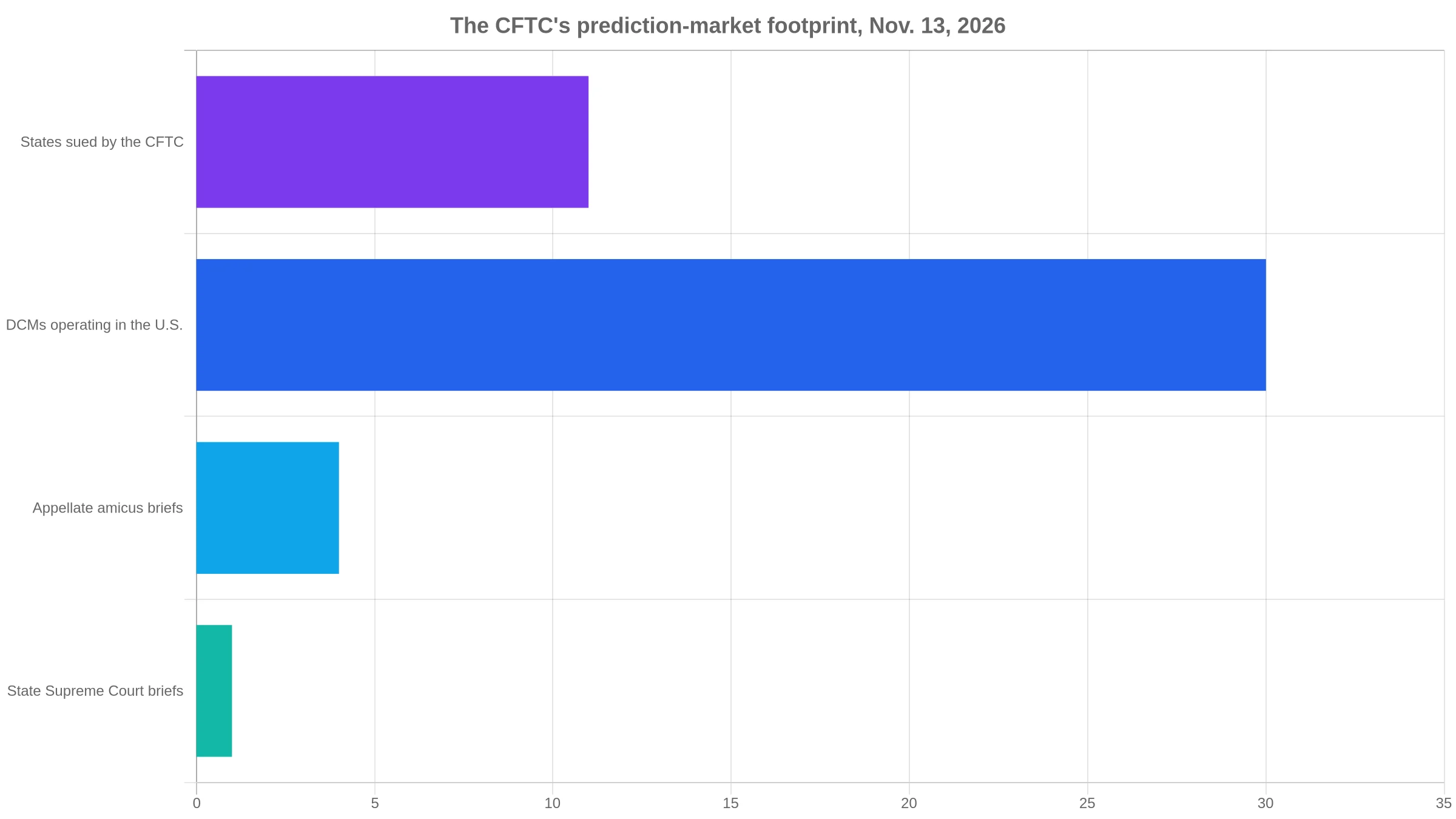
Arkansas is the eleventh state the CFTC has sued over event contracts, and the filing is the agency’s clearest test yet of a single proposition: that a state court cannot impose penalties on a federally registered exchange for listing contracts the commission has already allowed it to self-certify. The complaint asks for injunctive and declaratory relief, not damages, and it names the state and Griffin in his official capacity rather than Kalshi itself.
What Arkansas Filed on Nov. 4
According to the complaint , Arkansas opened its own enforcement action in state Circuit Court on Nov. 4, 2026, against KalshiEX LLC, the New York-based entity the commission approved as a contract market under Sections 5 and 6(a) of the Commodity Exchange Act. The state case seeks to halt event-contract trading and to impose civil penalties the CFTC describes as reaching “up to hundreds of millions of dollars.”
The commission’s pleading leans on a concession it attributes to the state: the complaint states that Arkansas “concedes that ‘Kalshi’s event contracts are structured as binary options.'” For the CFTC, that concession matters because the Commodity Exchange Act defines a swap to include agreements whose payment depends on the occurrence or nonoccurrence of an event with a financial, economic or commercial consequence, and binary options sit inside that definition.
Kalshi is not a defendant in the federal case. That detail shapes what the filing can achieve. The commission is not defending the exchange’s conduct in the abstract; it is asking a federal court to bar a state officer from enforcing a state judgment against a federally designated venue.
The Preemption Argument, Stated Narrowly
The legal architecture the commission invokes is old and specific. Section 2(a)(1)(A) of the Commodity Exchange Act gives the CFTC “exclusive jurisdiction” over futures, options and swaps traded on federally regulated exchanges, and the complaint argues that this framework expressly and impliedly preempts state laws that conflict with it, including under the Supremacy Clause. The operating rules for those exchanges, including the access standards at issue in the parallel interpretation, sit in 17 C.F.R. Part 38 .
That is a jurisdictional claim, not a merits claim about whether event contracts are good products. The complaint does not ask the court to decide whether sports and politics contracts serve a hedging purpose. It asks the court to decide who gets to regulate them. The distinction matters for how fast the case can move: a preemption ruling can arrive before the state case reaches judgment, while a factual dispute about the contracts’ economic function would take longer.
The commission has been building the regulatory side of that argument in parallel. On Oct. 19, 2026, it opened comment on proposed rules touching event contracts, published at 91 Fed. Reg. 65,969 and 91 Fed. Reg. 66,022. And the complaint notes memoranda of understanding with Major League Baseball, the National Basketball Association and the National Hockey League, an integrity framework the agency presents as an alternative to state oversight rather than a complement to it.
Eleven Suits, Four Circuits and One State Supreme Court
Arkansas is not an outlier in the commission’s docket. As the release puts it, “Arkansas is the 11th state the CFTC has sued to vindicate federal sovereign interests.” The agency also says it has filed amicus briefs in four federal Courts of Appeal and one state Supreme Court, which means the preemption question is already being litigated on several tracks at once.
The count moved quickly. When the commission issued its impartial-access interpretation on Nov. 5 , it was simultaneously litigating with ten states. The interpretation gave designated contract markets thirty days, a window that closes on Dec. 5, 2026, to stop restricting access by where a customer lives or to explain in writing why they cannot. Seven days later, Arkansas’s suit made it eleven.
That sequencing is the part state regulators will litigate hardest. The commission’s position is that a venue cannot comply with a federal access rule and a state prohibition at the same time, so the state rule must yield. Arkansas’s counter-position, as summarized in the federal complaint, is that it is enforcing its own consumer-protection and gambling statutes against a product it views as a wager, not a hedging instrument.
The Appellate Ruling That Cuts the Other Way
Filing eleven suits does not settle the law. On Sept. 28, the Sixth Circuit ruled that states can regulate Kalshi’s sports prediction markets , a decision that runs against the exclusive-jurisdiction theory the commission is now pressing in Arkansas and elsewhere. The CFTC’s complaint does not cite that ruling; it cites the statute, the legislative history of the 1974 Act and Supreme Court decisions from 1888 and 1905 on futures as a price-discovery mechanism.
The result is a split in posture rather than a settled question. District courts in eleven states now hold cases in which the same agency argues the same preemption point, while at least one federal appellate court has already allowed state regulation to proceed on a subset of the same contracts. A win in Arkansas would not bind the Sixth Circuit; a loss there would give the other ten cases a template.
Why the Venue Economics Turn on This
There are thirty designated contract markets operating in the United States today, according to the complaint, and the preemption question applies to all of them, not only to the venues that list sports and election contracts. If state gaming and consumer-protection laws apply venue by venue, every one of those markets faces a fifty-state compliance map, with licensing, geofencing and penalty exposure set locally. If federal preemption holds, the map collapses into one regulator.
For the exchanges, the practical cost is not the penalty in any single state case. It is the operating assumption that a product approved in Washington can be shut down in Little Rock, and the capital that assumption forces them to hold against state litigation. For the states, the cost of losing is the precedent that a federal agency can declare their consumer-protection statutes preempted before a court has decided what the product actually is.
The CFTC’s own framing puts the stakes in market-structure terms rather than consumer terms. In the release, Chairman Michael S. Selig said: “As prediction markets continue to prove their value in being useful for risk management and providing the public with valuable information about the future, Arkansas seeks to shut down event contracts ranging from sports and politics to other important world events.” He added: “The CFTC will continue to defend its sole jurisdiction over these federally regulated markets as granted by Congress under the Commodity Exchange Act, and the Commission will not let state interference thwart its regulatory efforts and destroy federally regulated markets.”
What the Complaint Does Not Decide
Nothing in the filing resolves whether event contracts are swaps for all purposes, whether Arkansas’s statutes are preempted, or whether the state’s penalties are enforceable. The commission has requested preliminary and permanent injunctive relief; as of publication, there is no public indication that a temporary restraining order has been granted, and the state case is not automatically stayed by the existence of a federal complaint.
Three further questions remain open. First, Kalshi is not a party to the federal suit, so any ruling will bind Arkansas and the commission before it binds the exchange’s own defenses in state court. Second, the commission has not published a figure for the penalties it says Arkansas seeks beyond the “hundreds of millions” characterization, which means the financial exposure is asserted rather than quantified in the pleading. Third, the Sixth Circuit’s September ruling gives Arkansas an appellate path that does not depend on winning in the Eastern District.
The one thing the filing does establish is a date. The commission’s thirty-day compliance window closes on Dec. 5, 2026, and every designated contract market that still restricts access by geography has to decide by then whether to test the commission’s theory or absorb the state-law risk of complying with it.
Frequently Asked Questions
Yes. The commission filed a complaint for injunctive and declaratory relief against the State of Arkansas and Attorney General Tim Griffin in the Eastern District of Arkansas. It was docketed on Nov. 12, 2026, as Case 4:26-cv-01255-BSM and announced on Nov. 13.
The commission’s target is the state enforcement action, not Kalshi’s conduct. It argues that the Commodity Exchange Act gives it exclusive jurisdiction over swaps traded on designated contract markets, so a state court cannot penalize an exchange for listing contracts the CFTC has allowed it to self-certify.
Arkansas’s attorney general filed an enforcement action in state Circuit Court against KalshiEX LLC, seeking to halt event-contract trading and to impose civil penalties that the CFTC describes as reaching up to hundreds of millions of dollars.
Not automatically. The commission has asked for preliminary and permanent injunctive relief, but a federal complaint does not stay a state proceeding on its own. A court has to grant relief before the state case is halted, and no such ruling was public as of Nov. 13, 2026.
Eleven. The commission said Arkansas is the eleventh state it has sued to vindicate federal jurisdiction over event contracts, and that it has also filed amicus briefs in four federal Courts of Appeal and one state Supreme Court.