



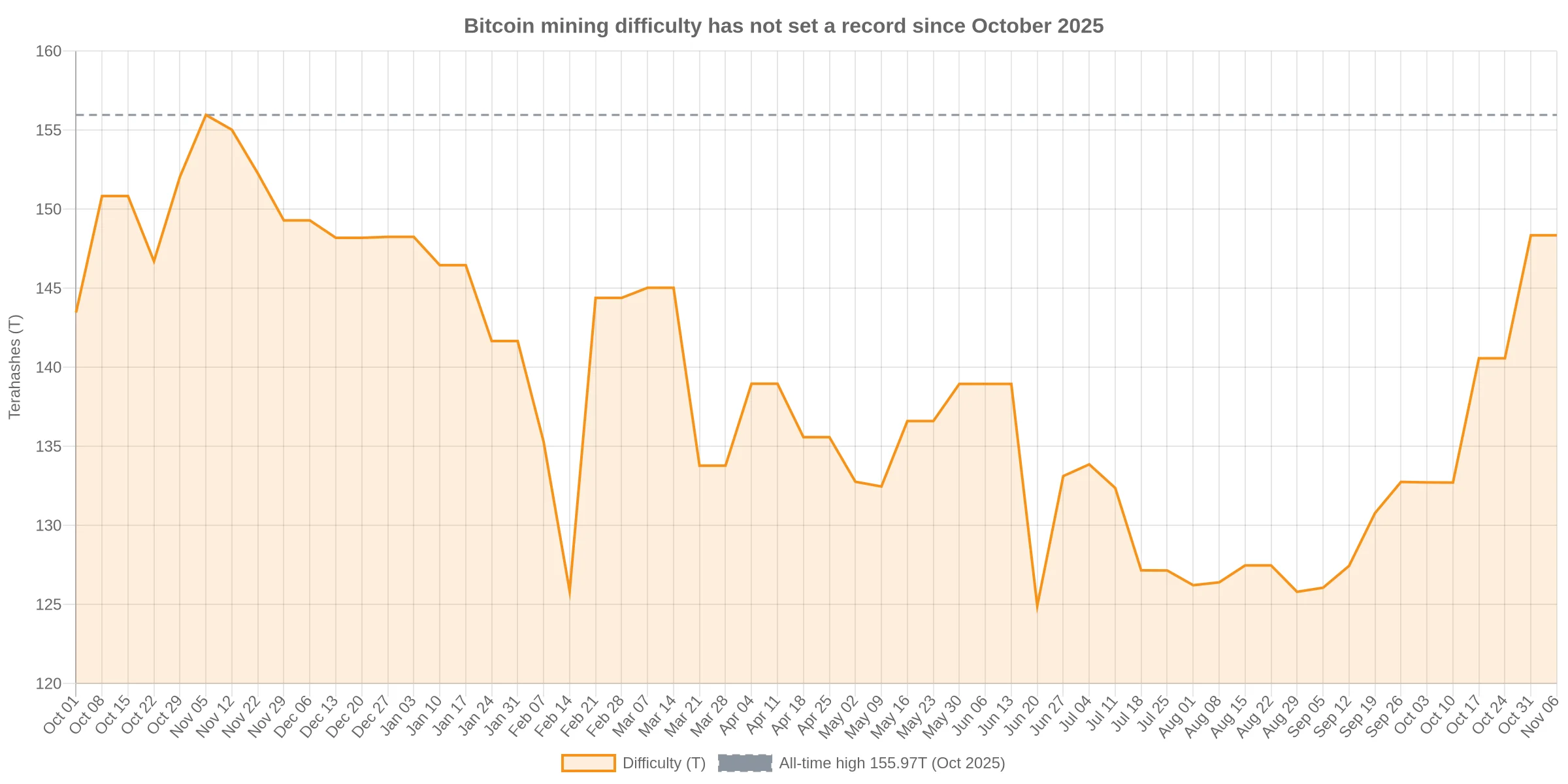
Bitcoin’s mining difficulty has not printed a new all-time high in 374 days. The metric stands at 148.36 trillion hashes after the retarget of 29 October 2026, which lifted it 5.54% from 140.58 trillion. The record remains 155.97 trillion, set at block 921,312 on 29 October 2025 at 10:14 UTC, according to mempool.space difficulty data . That leaves the network 4.88% below its peak, and spot Bitcoin at $75,577, down 2.5% over seven days and 7.6% over 30.
A year without a record is not a malfunction. Difficulty rises only when the network finds blocks faster than the ten-minute target, and it falls or stalls when hashrate growth slows or capital leaves. What makes this stretch unusual is its length. On daily difficulty samples, the current 356-day run below the record is the longest in the network’s history, ahead of the 348 days between August 2011 and July 2012, the 236 days from May 2021 to January 2022, and the 225 days from October 2018 to May 2019.
What 374 Days Without a Record Actually Measures
Bitcoin recalculates difficulty every 2,016 blocks, roughly two weeks of mining. The protocol compares the time taken for that batch against the 20,160 minutes implied by ten-minute blocks, then scales the target proportionally. If the batch arrived in nine minutes per block, difficulty climbs about 11%. If blocks slowed to twelve minutes, it drops.
The mechanism is self-limiting, which is why the record has held through a year of infrastructure building. Difficulty can only break out when hashrate expands faster than price. Between the record on 29 October 2025 and the most recent retarget exactly one year later, difficulty moved from 155.97 trillion to 148.36 trillion. Two separate retargets in the interim, on 3 October 2026 and 19 September 2026, produced 132.72 trillion and 132.76 trillion, so the network spent the northern autumn recovering ground it had already covered.
Hashrate tells a similar story. Current network hashrate sits near 1.02 zettahashes per second, with the 30-day peak at 1.22 ZH/s, based on blockchain.info’s hash-rate series. A rising hashrate that outruns price does not raise difficulty indefinitely. It raises the cost of production instead, until marginal operators switch off and the retarget resets the field.
The Revenue Number Sitting Behind the Stalled Record
Difficulty matters to miners because it converts into revenue per unit of computing power. The arithmetic is simple enough to run directly. Bitcoin issues 3.125 BTC per block and produces roughly 144 blocks a day, so 450 BTC enters the market daily. At $75,577, that is about $34.0 million of gross issuance value per day, or $12.4 billion annualized, before transaction fees.
Divide that by the network’s 1.02 ZH/s, which is 1.017 million petahashes, and the industry earns roughly $33.4 per petahash per second per day. That figure is the hashprice in everything but name. A month ago, with Bitcoin near $81,750 by CoinGecko’s 30-day change, the same hashrate would have produced about $36.2 per PH/s per day. Difficulty barely moved. Revenue per unit of power fell 7.6%.
That gap explains why miners did not respond to flat difficulty by adding machines. Adding hashrate when price falls simply lowers the industry’s return per petahash and raises the next difficulty adjustment in someone else’s favour. The rational move is to hold steady, sell coins, or repurpose the power.
The Cost Side of $33.4 a Petahash
Revenue per petahash only means something against the cost of running one. Take a current-generation machine rated at 20 joules per terahash. One petahash of that hardware draws 20 kilowatts, which is 480 kilowatt-hours a day. Against $33.4 of daily issuance revenue, the break-even power price works out to about 7.0 cents per kilowatt-hour, before fees, cooling, staff and hosting.
That single number explains most of the sector’s behaviour this year. An operator paying 4 cents keeps roughly $14 per petahash per day of gross margin. An operator paying 7.5 cents is losing money on the same machine at the same difficulty. Neither result depends on a new difficulty record; both depend on the price of Bitcoin, which has fallen 7.6% in 30 days.
Public Miners Are Selling Power, Not Hashrate
The clearest evidence of that shift came on 5 November, when Core Scientific reported third-quarter results that barely resemble a mining company. Colocation revenue rose nearly 60% sequentially to $215.4 million. The company billed for 485 megawatts as of 30 September, representing more than $700 million in average annualized colocation GAAP revenue. Net income reached $1.2 billion, a figure the filed earnings release attributes to “a non-cash gain in the change in fair value of warrants,” not to mining. Adjusted EBITDA more than tripled sequentially to $133.6 million on a 57% margin, up from 25%.
“Our execution at scale is translating into results, with a significant sequential increase in GAAP colocation revenue,” chief executive Adam Sullivan said in the release. “We are nearing full delivery under our first colocation agreement while construction under our second is underway across five campuses.” He added: “With revenue growing and substantial contracted capacity still to deliver, we have built a strong foundation for our next phase of growth.”
Put that $700 million annualized colocation book against the $12.4 billion the entire network earns from issuance each year, and one company’s real-estate and power business is worth about 5.6% of everything Bitcoin mining produces. The warrants-driven net income is worth flagging separately. A $1.2 billion profit that depends on the mark on warrants is a balance-sheet event, and investors who read it as operating strength will misprice the quarter.
This is the pattern BlockchainReporter documented when miners’ AI pivot decoupled their shares from Bitcoin , and again when AI contracts gave listed miners a valuation edge over pure-play operators. Flat difficulty does not hurt a company that is paid per megawatt of high-density colocation. It hurts the operator whose entire revenue line is the $33.4 per petahash.
What Would End the Streak
A new record requires hashrate to grow faster than the protocol can absorb, and the next decision point is close. The next retarget falls at block 975,744, with the chain at 974,990 at the time of writing, which places it around 12 November. Difficulty would need to climb 5.1% from 148.36 trillion to clear 155.97 trillion. The 29 October adjustment delivered 5.54%, so the arithmetic is not exotic; it is a question of whether the hashrate behind it exists.
Two conditions could produce it. A price recovery would restore miner margins and pull curtailed capacity back online, since the same machines become profitable at $81,750 that sit idle at $75,577. Alternatively, new capacity could come from operators with lower power costs or stranded energy contracts, which raises network hashrate without needing a higher Bitcoin price. Neither is visible in current data: the 30-day hashrate peak of 1.22 ZH/s has already faded to an average near 1.02 ZH/s.
The longer calendar matters too. The subsidy has been 3.125 BTC per block since April 2024, and the next halving sits at block 1,050,000. With the chain at 974,990, that is 75,010 blocks away, or roughly 521 days at the current pace of 144 blocks a day. A halving cuts the same hashprice by half unless price doubles, and it lands before the next difficulty record decision is settled in any meaningful sense.
The invalidation is explicit. If difficulty closes an epoch above 155.97 trillion, the 374-day gap ends and the record resets. Until then, the correct read is a network consolidating below its ceiling while its publicly traded operators shift revenue toward contracted colocation and away from a hashprice that no longer covers high-cost power. For traders, miner balance sheets are a supply variable to watch rather than a signal to chase. For anyone modelling hashprice, $33.4 per petahash per day is the number the whole industry is currently underwriting.
Frequently Asked Questions
148.36 trillion, set at the retarget of 29 October 2026. That is 4.88% below the all-time high of 155.97 trillion recorded on 29 October 2025 at block 921,312.
Difficulty only rises when blocks arrive faster than the ten-minute target. With Bitcoin near $75,577 and hashrate averaging about 1.02 ZH/s, miners have little incentive to add capacity, so the retargets of the past year have not been enough to clear the October 2025 peak.
Hashprice is daily revenue per unit of computing power. At 450 BTC of daily issuance and $75,577 per coin, the network earns about $34.0 million a day, or roughly $33.4 per petahash per second per day before fees. Falling hashprice squeezes miners even when difficulty is flat.
The next retarget falls at block 975,744. With the chain at 974,990 at the time of writing, that places the adjustment around 12 November 2026. Clearing the record would require a 5.1% increase.
A Bitcoin price recovery that restores miner margins, or new low-cost capacity coming online from operators with cheaper power. The 30-day hashrate peak of 1.22 ZH/s shows the capacity exists, but it has not been sustained.
Data: mempool.space , CoinGecko , Blockchain.com difficulty and hash-rate series.
This article is for information only and is not investment advice. Crypto assets are volatile and mining economics vary by operator, energy contract and hardware efficiency.