XRP is struggling to hold the $1.40 level as persistent selling pressure continues to weigh on market sentiment. Price action remains fragile, reflecting broader uncertainty across the crypto sector. Bitcoin continues to trade within a range, offering limited directional clarity in the short term. This lack of decisive momentum is filtering through the market, leaving altcoins — including XRP — particularly vulnerable to underperformance in the absence of a strong macro trend.
Recent market activity has also drawn attention to exchange flows. Binance absorbed a massive inflow this week, cementing its status as the premier venue for high-volume transactions. On-chain data shows that more than 31 million XRP were transferred to the exchange in a single day yesterday, a movement that naturally raises questions about potential short-term supply dynamics.
Large inflows to exchanges can sometimes precede selling activity , although they do not guarantee immediate distribution. They may also reflect repositioning, hedging, or internal liquidity management. Still, in a market already facing cautious sentiment, such flows tend to reinforce short-term uncertainty around XRP’s price stability.
Large Holder Inflows Raise Short-Term Sell Pressure Concerns
On-chain breakdowns show that the recent inflows were largely driven by larger holder cohorts, reinforcing the view that this was not retail-led activity. Addresses holding less than 1,000 XRP accounted for just 6,543 tokens, while the 1,000–10,000 bracket contributed 73,630 XRP. In contrast, the bulk of the movement originated from higher tiers: 10,000–100,000 holders transferred 2,938,809 XRP, the 100,000–1 million cohort moved 14,236,825 XRP, and wallets holding more than 1 million XRP sent 14,494,865 tokens to Binance.

This distribution highlights that the overwhelming share of the 31 million XRP inflow came from large participants. At current price levels, the aggregate transfer represents nearly $45 million in potential sell-side liquidity. While exchange inflows do not automatically translate into immediate liquidation, they do increase the amount of readily tradable supply on the order books.
In a market already facing muted momentum and broader uncertainty, such a concentration of large-holder deposits warrants close monitoring. If these flows evolve into sustained distribution, XRP could face renewed downward pressure. Under those conditions, the asset may struggle to stage a meaningful recovery from its ongoing corrective phase in the near term.
XRP Tests Structural Support As Downtrend Persists
XRP continues to trade under sustained technical pressure, with the 3-day chart confirming a broader corrective structure that began after the 2025 peak above $3.50. Since that high, price action has formed a sequence of lower highs and lower lows, signaling weakening bullish momentum rather than consolidation. The most recent decline toward the $1.30–$1.40 region places XRP at a critical support zone that previously acted as a launchpad during earlier expansion phases.
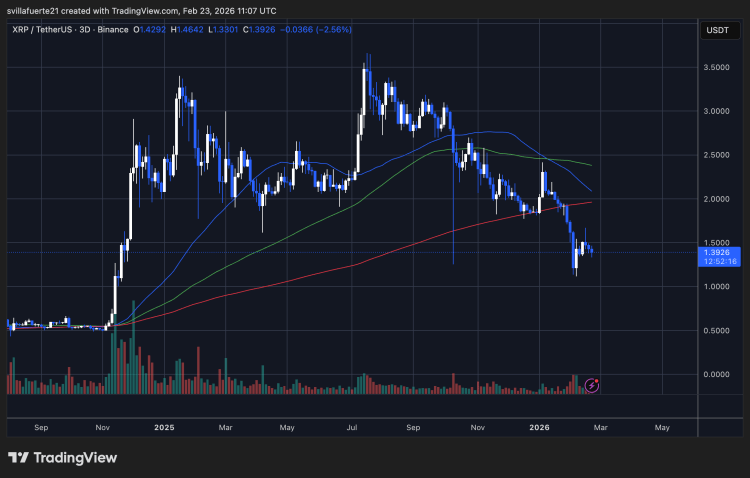
Technically, XRP is trading below the shorter- and medium-term moving averages, both of which are now sloping downward and acting as dynamic resistance. The longer-term average remains upward sloping but has flattened noticeably, reflecting fading macro momentum. Until price reclaims the $1.80–$2.00 range with strong volume, upside attempts are likely to face supply pressure near these moving averages.
Volume has moderated compared with the impulsive rally phase, suggesting reduced speculative participation. However, recent spikes during sharp selloffs indicate active distribution rather than passive drift.
If the $1.30 support region fails decisively, a deeper retracement toward the $1.10–$1.20 zone becomes plausible. Conversely, stabilization above current levels could open the door to a short-term relief bounce, though broader structure remains fragile.
Featured image from ChatGPT, chart from TradingView.com