

Lightning Network capacity hit a new high this week as major exchanges put more Bitcoin into off-chain channels, boosting the network’s total liquidity and changing how users move BTC.
Exchange Support Drives Capacity
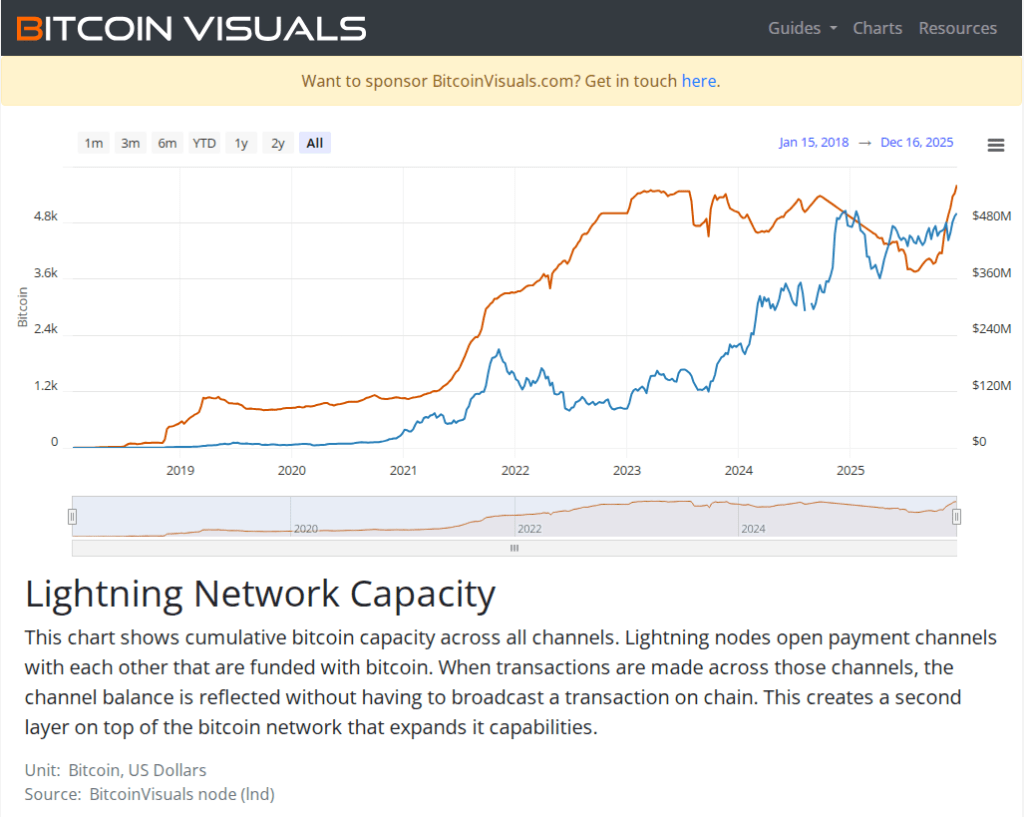
According to reports , the Lightning Network’s public capacity climbed to about 5,606 BTC, with some trackers briefly showing a peak near 5,637 BTC. That is a clear uptick from earlier levels and marks the highest recorded total so far.
Exchanges including Binance and OKX have been named as contributors that added Bitcoin to Lightning channels, and other platforms such as Kraken and Bitfinex are expanding their support as well. These deposits are aimed at speeding up deposits and withdrawals and cutting fees for customers.
Network Activity Vs. Public Nodes
Based on reports, that increase in capacity has not been matched by a big rise in the number of public nodes or channels. Public node counts sit near 14,940, while public channels are roughly 48,678.
In other words, more Bitcoin is available inside the network, but the number of hands handling traffic has not jumped in the same way. Some of this extra liquidity is concentrated in larger, custodial channels run by exchanges, which can move big sums without creating many new public routes.
That makes on-chain metrics a bit harder to read. Transaction counts and on-chain fee savings do show real user benefits, even when the node graph looks stable.
A separate figure that shows real usage is the share of exchange traffic routed over Lightning . Based on reports, one exchange has routed around 15% of its Bitcoin transactions via Lightning rails after adopting Lightning integrations, pointing to meaningful operational changes at major platforms.
New Use Cases And FundingFunding and protocol work are following capacity growth. Tether led a round that raised about $8 million for a startup focused on payments over Lightning, indicating interest in stablecoin flows on the network.
Announcing Taproot Assets v0.7, now with reusable addresses, a fully auditable asset supply, and larger, more reliable transactions.

With this release, we are laying the foundation for trillions of dollars to flow on bitcoin and Lightning.

Read more below. Upgrade today!
— Lightning Labs

(@lightning) December 16, 2025
Protocol upgrades — including work around Taproot-related asset handling and reliability improvements — are also being rolled out to support more varied payments and token types. These developments point to Lightning being used for things beyond tiny tips: remittances, merchant payments, and stablecoin transfers are being tested more widely.
Market watchers say this mix of exchange liquidity, developer upgrades, and rising on-platform usage could make Lightning a more practical rail for everyday BTC movement.
Some critics warn that heavier reliance on custodial channels raises centralization risks and reduces the visibility of true peer-to-peer routing. Others note that improved user experience, lower costs, and faster finality are what ordinary users will notice first.
Featured image from Unsplash, chart from TradingView