



Bitcoin changes hands at $59,870 and ether at $1,669.58, and the Crypto Fear and Greed Index prints 12 — Extreme Fear — for the fifth session in a row. The tape under that index is not behaving like a panic. Of the top 100 tokens by market capitalisation, 59 are higher over 24 hours and the median move is +0.01%, according to CoinGecko’s market data read at 19:08 UTC on 27 November.
That split is the useful thing on the board tonight. A sentiment reading of 12 measures how far prices have travelled from their highs and how unstable the past two months have been. A breadth count of 59 up out of 100 measures what happened in the last day. The first is bleak, the second is close to flat, and the difference decides whether the next $1,000 committed to this market is buying a falling knife or a stabilising range.
What $1,000 Buys at 19:08 UTC on 27 November
The arithmetic is unforgiving for anyone who bought the 2025 highs and clarifying for anyone starting now. Bitcoin at $59,870 buys 0.0167 BTC per $1,000. Ether at $1,669.58 buys 0.599 ETH. The same money buys 13.9 SOL at $71.96, 15.67 HYPE at $63.81, 1.34 ZEC at $746.48, or 1,052 XRP at $0.9509.
Those unit counts only matter against a reference point. Bitcoin’s all-time high was $126,080 on 6 October 2025, which is 110.6% above the current price; the same $1,000 would be worth $2,106 at that level. Ether’s high was $4,946.05 on 24 August 2025, 196.2% above spot, which would turn the same $1,000 into $2,962. A simple double needs $119,740 for bitcoin and $3,339 for ether.
| Asset | Price, 19:08 UTC | 24 hours | Market cap | Units per $1,000 |
|---|---|---|---|---|
| Bitcoin (BTC) | $59,870 | -0.97% | $1.204 trillion | 0.0167 |
| Ether (ETH) | $1,669.58 | -1.74% | $204.1 billion | 0.599 |
| Solana (SOL) | $71.96 | +1.01% | $42.6 billion | 13.9 |
| Hyperliquid (HYPE) | $63.81 | +3.21% | $15.2 billion | 15.67 |
| Zcash (ZEC) | $746.48 | +4.67% | $12.7 billion | 1.34 |
| XRP | $0.9509 | -0.17% | $60.4 billion | 1,052 |
The names on that list are not falling together. Bitcoin is down 0.97% and ether 1.74%, while solana, HYPE and ZEC are green on the day. Relative strength inside a drawdown is not proof of anything durable, but it does mark where sellers have stopped pressing.
Fear at 12, Breadth at 59 Up: Two Readings That Disagree
The Crypto Fear and Greed Index has printed 12, 11, 13, 11 and 11 across the last five daily readings, all classified Extreme Fear. Five consecutive sessions at 13 or below is a narrow band even for a market that has spent two months distributing.
Inside the same 24 hours, the distribution of movers is close to balanced. Forty of the top 100 fell, 59 rose, and one was unchanged. Six names lost more than 5%: WLFI at -11.4%, PEARL at -11.0%, monero at -8.3%, RAIN at -7.6%, BDX at -7.3% and PI at -7.0%. On the other side, a small-cap called BTW gained 18.8%, RENDER 5.5%, NIGHT 4.7%, LIT 4.6%, ZEC 4.5% and JUP 3.7%. The median token moved 0.01%, which is the number that matters more than the index: half the market was flat to higher while the sentiment gauge sat at 12.
Two different questions are being answered. The index asks how bad the last month felt. Breadth asks what happened today. When the first is at 12 and the second is at 59 up, the fear is historical rather than live: it is the residue of a 52.5% bitcoin drawdown, not evidence that holders are selling into this hour. That reading would flip if breadth turned negative while the index stayed pinned, which has not happened yet.
Both Majors Sit 8.6% Above Their 100-Day Low
Using daily closes from Binance’s public candle feed through 27 November, bitcoin’s 100-day range runs from $55,130 to $87,395.67. Spot at $59,870 is 8.6% above the low and 31.5% below the high. Ether’s 100-day range is $1,538 to $2,807.34, leaving spot 8.56% above the low and 40.5% below the high. The two majors are sitting on the same percentage cushion above the same kind of floor.
Both are also below every average that trend followers watch. Bitcoin is 8.2% under its 20-day average of $65,235.99, 19.5% under its 50-day average of $74,345.36 and 22.7% under its 100-day average of $77,445.30. Ether is 8.7% under $1,829.23, 22.5% under $2,153.83 and 29.0% under $2,352.65. That configuration is a downtrend by construction, whatever the daily breadth says.
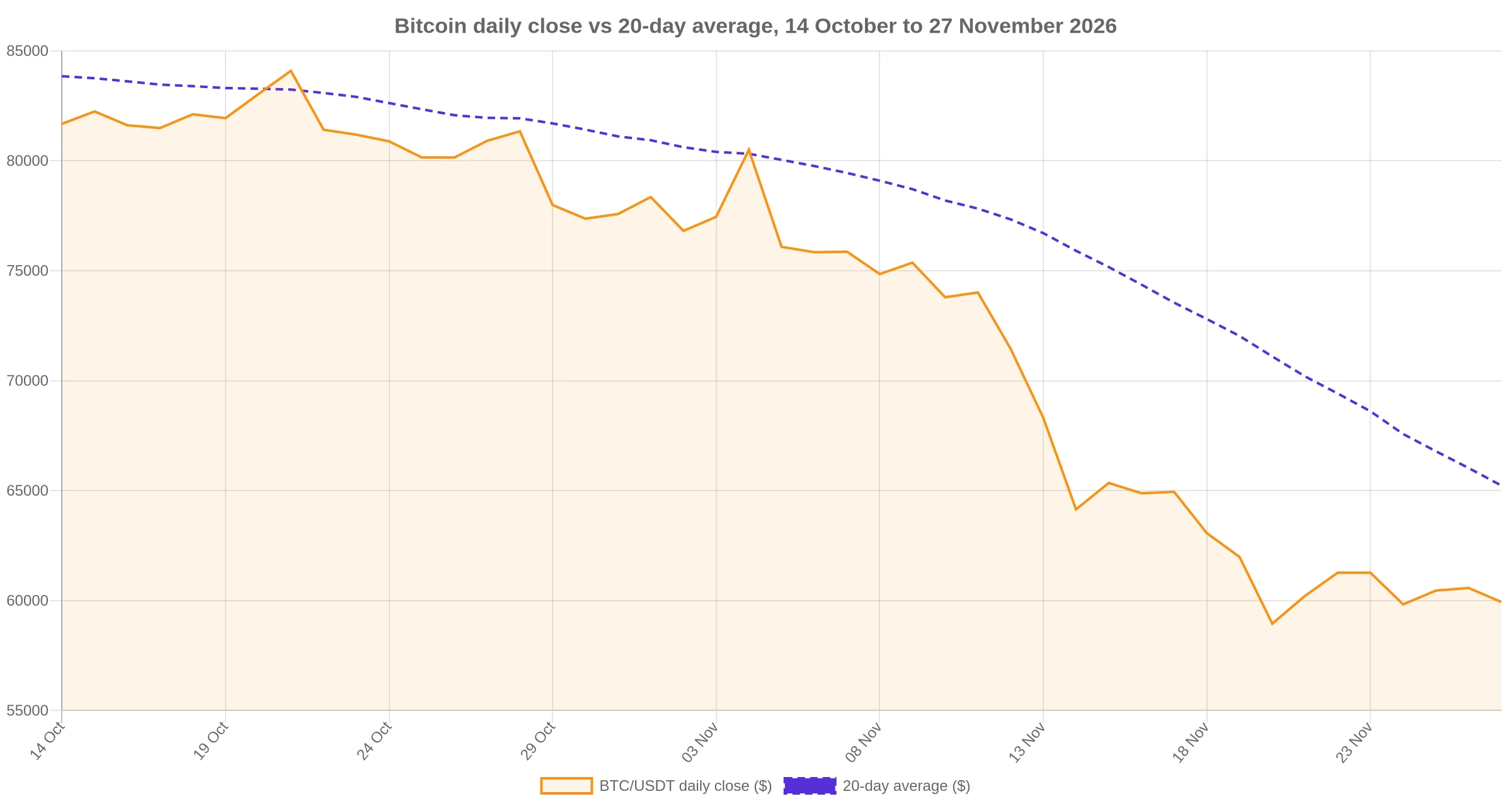
Volume is the missing ingredient for either resolution. Bitcoin’s 27 November session has traded about $1.17 billion on Binance’s spot pair, 22.5% below the 20-day average of $1.51 billion. A test of the $55,130 low on shrinking volume is a different event from a break of it on expanding volume, and the difference is the only thing that separates a retest from a reset. The same logic applies upward: the first resistance is the 20-day average at $65,236, then the 20-day high at $76,200, and a close through the average on below-average volume would carry little information.
The comparison with 25 November is instructive. Bitcoin was trading near $58,300 when Core PCE printed 3.3% and third-quarter growth was revised up, a combination that weakened the case for near-term cuts, as we mapped at the time . Two sessions later spot is $59,870, roughly $1,600 higher, and the sentiment index has not recovered. Price stopped falling before the narrative did.
What Ether Has That Bitcoin Does Not: a Dated Test at 40.5% Off
The weakness shows up in the ratio before it shows up in the calendar. One ether buys 0.02789 bitcoin, against 0.02905 on 27 October, a 4.0% loss of relative value in a month when bitcoin itself fell. Ether is also 40.5% below its 100-day high of $2,807.34, deeper than bitcoin’s 31.5% gap. Both facts describe the same underperformance.
What ether has and bitcoin does not is a dated event to price against. A client-configuration pull request opened on 26 November in the eth-clients repository proposes Glamsterdam on Hoodi at epoch 143616 , and its description is specific: “Gloas/Amsterdam now activates at epoch 143616 (slot 4595712, an accumulator boundary), timestamp 1797361944, Tuesday 15 December 2026 19:12:24 UTC, with Gloas fork version 0x80000910.” The same change sets the gas limit to 200 million at the fork epoch.
Status matters as much as the date. The pull request is open, not merged, and the decision it implements was framed on the 26 November All Core Devs consensus call as conditional: the agenda asked participants to “set a Hoodi fork date in w/b 14 December (if EL is go) or postpone”, according to the published call agenda . Hoodi previously carried a 26 October activation, which was removed by a separate pull request on 22 October. A testnet fork is a rehearsal, not a mainnet date, and it does not change ether supply on its own; the mechanics of the rescheduling are set out here .
The pricing consequence is narrow but real. A dated hurdle gives a position something to be measured against, and ether has had none since the October date was pulled. A second slip would leave the calendar empty again.
What Would Break the Arithmetic
The supportive reading of this tape rests on two numbers: $55,130 and $1,538. A daily close below either voids the 8.6% cushion and puts both majors into price discovery under their November floors, at which point the fear index at 12 stops being a contrarian signal and becomes a description.
The second condition is participation. Nothing in the last week’s data shows buyers arriving in size: bitcoin’s volume sits below its 20-day average, and the sentiment index has been pinned for five sessions. A rally that clears $65,236 without volume would leave the same untested lows underneath.
What the data does not establish is why prices fell in the first place. The available evidence is a sequence: a 52.5% bitcoin drawdown from October 2025, five sessions of extreme fear, a 4.0% monthly loss of ether’s ratio to bitcoin, plus a macro print on 25 November that weakened the case for cuts. That is correlation and chronology, not a proven cause, and treating one headline as the driver would be a guess dressed as analysis.
Frequently Asked Questions
No price table answers that question, and this article does not make a recommendation. What the data shows at 19:08 UTC on 27 November: bitcoin at $59,870 sits 8.6% above its 100-day low of $55,130 and 52.5% below its all-time high, ether at $1,669.58 sits 8.56% above $1,538 and 66.2% below its high, and both trade under their 20-day, 50-day and 100-day averages. The decision that matters is whether those floors hold, not which ticker looks cheapest.
The index blends volatility, market momentum, trading volume, bitcoin dominance and social trends into a single 0-100 reading. A score of 12 is classified Extreme Fear and describes a market that has fallen sharply and stayed unstable for weeks. It has printed 12, 11, 13, 11 and 11 over five sessions, which means it is measuring the same conditions repeatedly rather than deteriorating further.
Ether is cheaper relative to its own history: it is 66.2% below its August 2025 high of $4,946.05, against bitcoin’s 52.5% below $126,080. It is also weaker against bitcoin, with the ETH/BTC ratio at 0.02789 versus 0.02905 on 27 October. A larger drawdown means more room to recover and more evidence of underperformance, which are the same fact read two ways.
The first objective marker is a daily close above the 20-day average at $65,236, ideally with volume above the 20-day average of $1.51 billion. Above that, the 20-day high of $76,200 is the next reference. On the downside, a daily close below $55,130 would invalidate the current base and remove the 8.6% cushion entirely.
Hoodi, Ethereum’s main public testnet, is scheduled to activate the Glamsterdam upgrade at 19:12:24 UTC on 15 December 2026, epoch 143616 and slot 4595712, under an open client-configuration pull request filed on 26 November. It is a testnet rehearsal: it does not activate the upgrade on mainnet, does not change ether issuance by itself, and the pull request is still awaiting merge.
Disclosure: This article does not represent investment advice. The content and materials featured on this page are for educational purposes only.
The post Best Crypto to Buy Now: Bitcoin Below $60K as Fear Holds at 12 for a Fifth Day appeared first on BlockchainReporter .