


The Grayscale Zcash Trust ETF recorded a daily flow of exactly zero dollars on 17 November. No subscription, no redemption, nothing to explain in a fund whose flow column has been a list of small negatives for three weeks. Zcash itself traded at $922.49 at 16:50 UTC on 18 November, down 0.92% over 24 hours and 4.48% over seven days, according to CoinGecko’s ZEC market data . Bitcoin fell 14.08% over the same week and traded at $62,446.18 on 18 November, its lowest reading in thirty days.
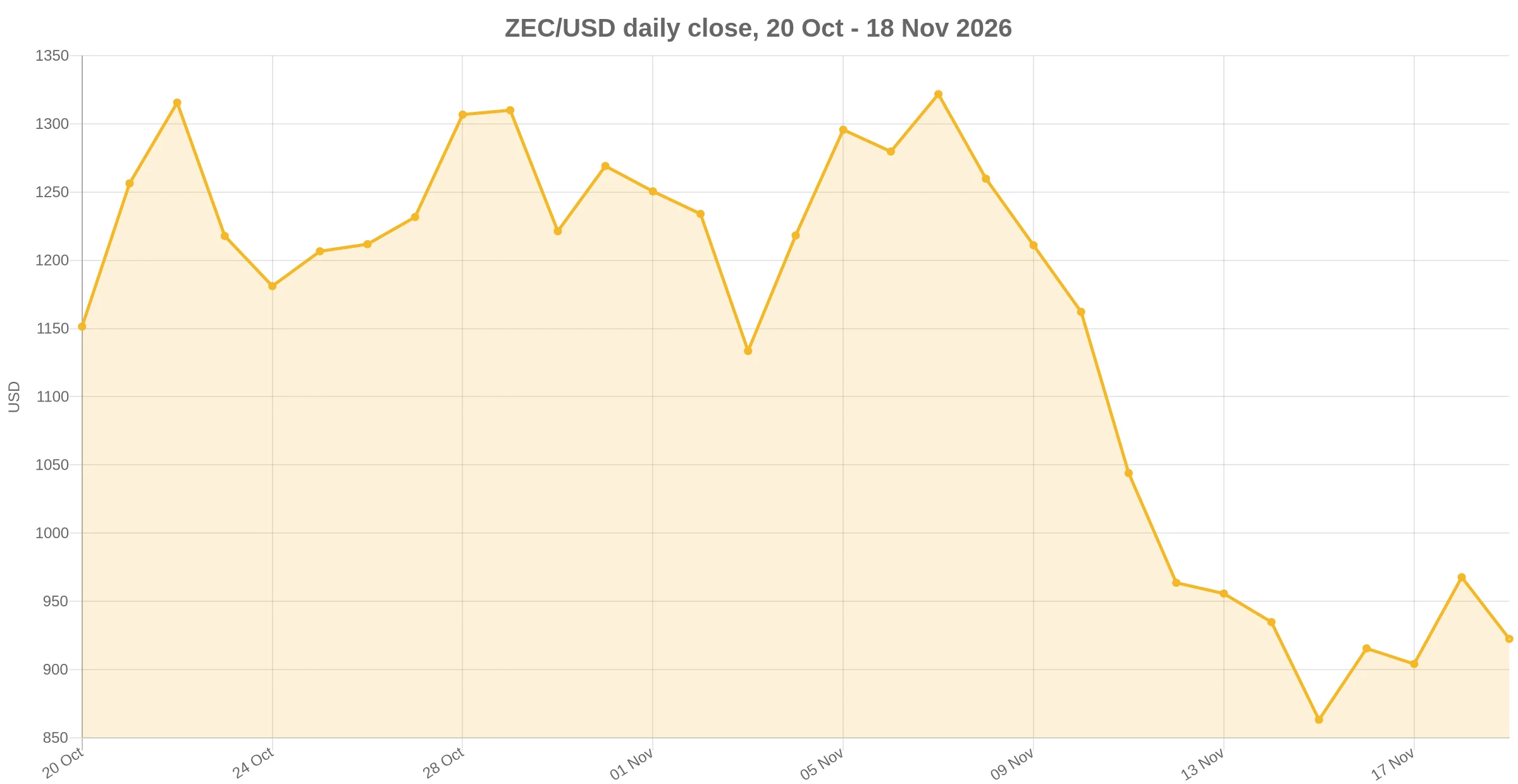
The two facts sit awkwardly together, and that is the story. A token with no new ETF money is holding up better than the asset that institutional flows are still pricing. On 7 November, Zcash closed at $1,321.77 and bitcoin at $75,775.28. By 18 November, Zcash had lost 30.21% of that value and bitcoin 17.59%. Yet over the last seven days the ranking reverses completely. The gap is not demand. It is the order in which the two assets sold off, and the arithmetic of a ratio that spent a week healing while the larger market kept falling.
Bitcoin Made a 30-Day Low. Zcash Did Not.
Bitcoin’s 18 November reading of $62,446.18 is its weakest in thirty sessions, below the $64,840.87 it printed on 17 November and below everything the coin recorded since 20 October, when the window opens at $81,875.26. Zcash’s thirty-day low came at $863.24, and the token is currently 6.86% above it. That difference in position is the mechanical reason ZEC outperformed this week: it had already absorbed its drawdown earlier, between the 7 November high close of $1,321.77 and the 14 November close of $934.81, a 29.3% decline in five sessions. Bitcoin was still working through the first leg of its own.
The cleanest measure is the ratio, not the dollar price. One ZEC bought 0.013026 BTC a week ago. At 16:50 UTC on 18 November it bought 0.014773 BTC, an increase of 13.4% in seven days. Measured from the 14 November close, when the ratio bottomed at 0.013684, the recovery is 7.96%. That is what outperformance looks like when it comes from the denominator falling faster than the numerator: bitcoin lost 8.59% between 14 and 18 November while Zcash lost 1.32%.
None of this says buyers are accumulating Zcash. It says the coin stopped going down before bitcoin did, which is what happens to a high-beta asset after it has already fallen 29% in a week. The same pattern would appear in any token that peaked early. What distinguishes Zcash is the size of the earlier move and the absence of fresh capital behind the bounce.
What Thirteen Sessions of Zcash ETF Flows Add Up To
The only US-listed Zcash ETF wrapper in the flow tracker is ZCSH, and its record since 30 October is a study in attrition. Thirteen sessions, nine of them negative, two positive, two flat. The negatives run from a $4.60 million redemption on 30 October to $14.60 million on 11 November, $9.90 million on 12 November, $4.10 million on 13 November and $9.00 million on 16 November. The positives were $3.40 million on 4 November and $1.80 million on 6 November. Net across the thirteen sessions: minus $57.40 million, according to Farside Investors’ Zcash ETF flow record .
That outflow is 31.1% of the fund’s cumulative $184.70 million of net creations since launch, a figure still carried by a single session that took in $112.10 million. The fund charges 2.5%. Its worst day was a $30.20 million redemption; its average session is plus $3.20 million, a number that only stays positive because of the launch days.
Scale matters when reading those numbers next to bitcoin. US spot bitcoin ETFs lost $239.90 million on 17 November alone, with BlackRock’s IBIT accounting for $209.50 million of it, Grayscale’s converted GBTC $17.70 million and ARKB $13.10 million, per the same tracker. US spot ether ETFs lost $29.10 million the same day, $27.60 million of it from ETHA. ZCSH’s entire thirteen-session bleed is 24% of one day of bitcoin ETF outflows. The Zcash fund is a small wrapper on a $15.7 billion asset, and its flows tell you more about who holds the wrapper than about who wants the coin.
The Supply Arithmetic Behind a $15.7 Billion Market Cap
At $922.49, the 17,048,694 ZEC in circulation are worth $15.73 billion, which is 0.73% of the $2.16 trillion total crypto market and roughly 1.25% of bitcoin’s $1.26 trillion. The supply is 81.2% of the 21 million cap. Those numbers make the price levels easy to translate: a move back to $1,000 would put the market value at $17.05 billion, and a return to the 7 November close of $1,321.77 would restore $22.53 billion, which is where the token sat before its five-session slide.
Turnover is running hotter than bitcoin’s. ZEC has traded $616.7 million in the past 24 hours against its $15.73 billion market value, a 3.9% turnover; bitcoin’s $28.25 billion against $1.26 trillion is 2.2%. Thin markets with high turnover are where ratios like this week’s get made, and where they can reverse just as quickly.
Ownership is concentrated enough to matter. Cypherpunk Technologies told the SEC in a Form 8-K on 16 November that it holds 341,858.75 ZEC, or 2.01% of circulating supply , after mining 8,967.29 ZEC in 44 days. At today’s price that treasury is worth $315.4 million. One Nasdaq-listed miner holding 2% of the float is a structural fact about Zcash that has no equivalent in bitcoin’s holder base, and it is a two-way risk: the same disclosure that shows conviction also shows how much supply one balance sheet could return to the market.
The Levels, and What Would Prove This Week Was Rotation, Not Demand
Three prices frame the next decision, and each has a basis rather than a story. The first is $863.24, the lowest daily close of the past thirty sessions, set during the 14 November liquidation. A daily close below it would mean the bounce failed and the 7 November peak marked a distribution top rather than a pause. The second is $963.59, the close of 11 November, which is the level Zcash has to reclaim to erase the seven-day loss entirely. The third is $1,321.77, the 7 November close and the thirty-day high, which is 43.3% above today’s price.
The ratio gives a cleaner test than any dollar level. If Zcash holds above 0.0140 BTC per coin while bitcoin stabilises, the move was a rotation into an asset that had already repriced. If the ratio falls back under 0.0130, the level it held a week ago, then this week’s outperformance was borrowed time and the token is simply following bitcoin down with a delay. That distinction is checkable within days, which is more than can be said for most claims made about relative strength.
Two scheduled items sit inside that window. Polling on Zcash Community Grants’ 8% share of the block reward opened on 16 November and closes on 30 November, the governance question that has run alongside the price since NU7 tripled the block rate. Those polls decide how the dev fund is funded, not how much ZEC exists, and anyone trading the outcome should keep the two separate. The other is the flow record itself: ZCSH has not posted two consecutive positive sessions in the thirteen sessions since 30 October, and until it does, the fund is not confirming what the ratio is implying.
Frequently Asked Questions
Zcash traded at $922.49 at 16:50 UTC on 18 November 2026, down 0.92% in 24 hours, 4.48% in seven days and 18.04% in thirty days, according to CoinGecko. Its market value is $15.73 billion on a circulating supply of 17.05 million ZEC.
Because it fell earlier. Zcash lost 29.3% between its 7 November close of $1,321.77 and its 14 November close of $934.81, while bitcoin was still declining through 18 November, when it set a thirty-day low at $62,446.18. The ZEC/BTC ratio rose from 0.013026 to 0.014773 in seven days, a 13.4% gain driven mainly by bitcoin’s fall.
The US-listed ZCSH fund has taken in $184.70 million net since launch, but has lost $57.40 million across the thirteen sessions from 30 October to 17 November, with nine negative days and a zero print on 17 November, per Farside Investors.
Support sits at $863.24, the thirty-day low close set on 14 November. Resistance runs through $963.59, the 11 November close, and then $1,321.77, the 7 November close. A daily close below $863.24 would invalidate the rebound thesis, and a ZEC/BTC ratio below 0.0130 would show the outperformance has ended.
A renewed bitcoin drawdown, a resumption of ZCSH redemptions after the 17 November flat print, or selling from concentrated holders such as Cypherpunk Technologies, which reported 341,858.75 ZEC, or 2.01% of supply, in a 16 November SEC filing. Turnover of 3.9% of market value in 24 hours means moves can extend quickly in both directions.
Disclosure: This article does not represent investment advice. The content and materials featured on this page are for educational purposes only.
Data: Farside Investors , CoinGecko .
The post Zcash Price Today: ZEC Holds Above $900 as 13 ETF Sessions Bleed $57 Million appeared first on BlockchainReporter .