



Broadridge’s Distributed Ledger Repo settled $7.6 trillion of repo transactions in October, an average of $345 billion on each settlement day, the company said on November 6. The total is the platform’s headline number for the month, and it arrives at the end of a year in which tokenized collateral moved out of pilot decks and into the funding plumbing that dealers use to finance their books.
The figures come from Broadridge’s October volume release , which describes DLR as the world’s largest institutional platform for settling tokenized real assets and ties the month’s activity to the company’s newer DLX platform. Broadridge is a New York-listed fintech whose systems underpin a daily average of more than $18 trillion in tokenized and traditional securities trading, according to the same release.
What the $7.6 Trillion Actually Contains
Broadridge does not publish a settlement-day count alongside its monthly volume, but the two numbers it does disclose are enough to reconstruct one. Dividing $7.6 trillion by $345 billion gives 22.03, which lines up with October 2026’s 22 weekdays and no US market holiday falling inside the month.
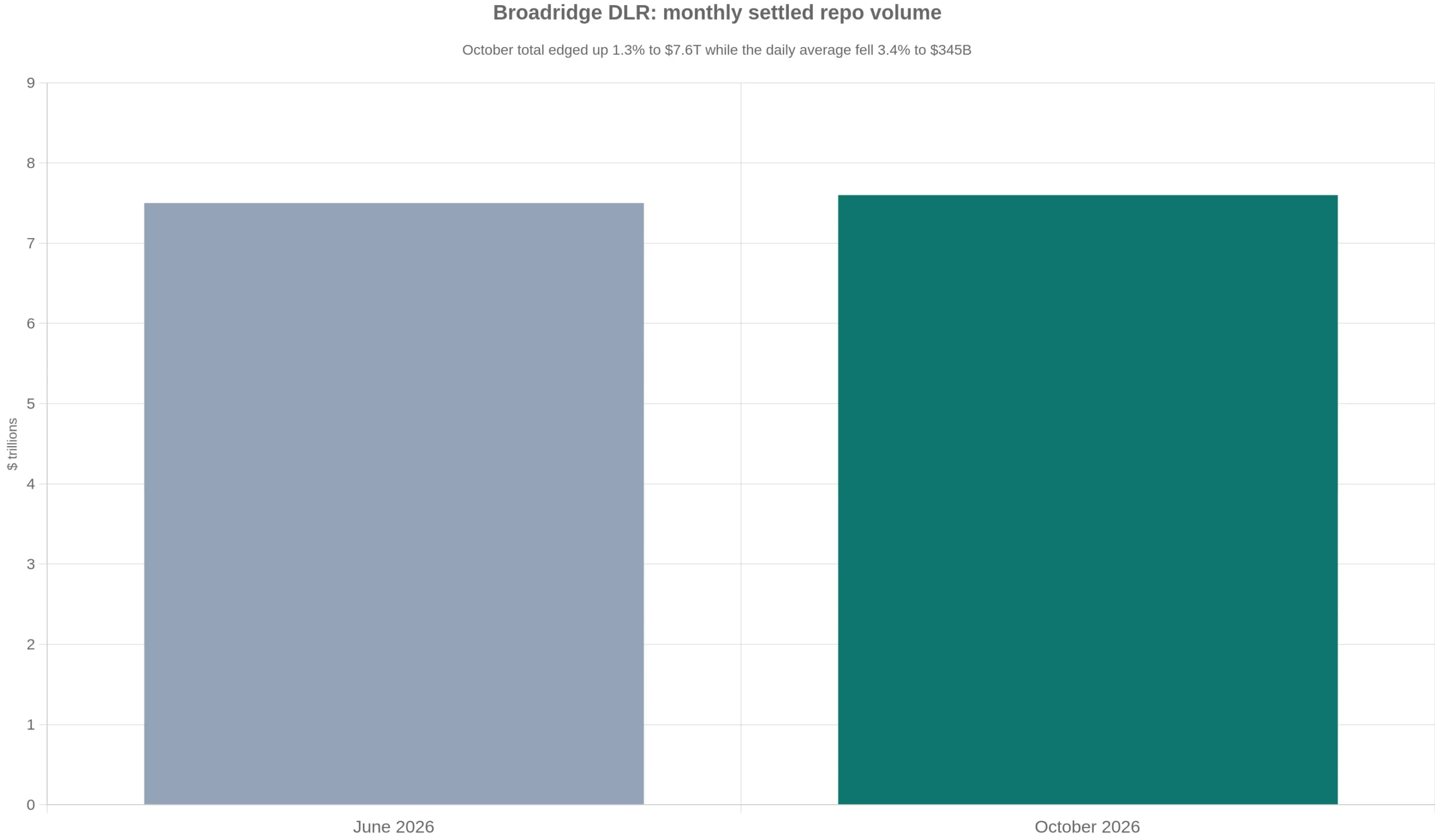
The same arithmetic applied to the company’s previous public data point produces a less flattering comparison. Broadridge’s DLR product page still carries a June 2026 snapshot of $357 billion in average daily settled volume against $7.5 trillion for the month, a ratio of 21.0 that matches June’s 21 trading days once Juneteenth is removed from the calendar.
Set side by side, the monthly total rose 1.3% while the daily average fell 3.4%. The difference is calendar, not demand: one extra settlement day in October spread a slightly larger pool of activity across a longer month. Anyone reading the $7.6 trillion as an acceleration is reading a month with 22 working days against a month with 21.
Two further ratios put the figure in context. At $345 billion a day and 252 settlement days a year, DLR is running at roughly $86.9 trillion annualized. Against the $18 trillion in daily securities trading that Broadridge says its platforms support, tokenized repo represents about 1.9% of the franchise. The comparison is imperfect, because DLR counts financing transactions that roll repeatedly while the $18 trillion covers trading across products, but it shows how much room the platform still has inside its own parent.
Why Repo Carries the Volume and Equities Do Not
Repo is an odd place for tokenization to succeed first, until the mechanics are laid out. A repo trade is short-dated, collateral-heavy and operationally expensive. The desks that run it care about how fast collateral can be moved, how much of it can be reused during the day, and how many reconciliations and disputes each transaction generates. Price discovery is not the problem. Settlement is.
Broadridge’s own description of the platform follows that logic. DLR advertises intraday repo that lets counterparties lend and borrow cash during the trading day, a “shell” structure for using collateral held away in segregated, no-lien accounts, and the ability to post tokenized Treasuries against intraday funding needs. The platform runs on Canton , a privacy-enabled blockchain network, and Broadridge lists collaborations with HQLAX on securities finance, Fnality on wholesale settlement and Kaiko on market data, plus participation in the Regulated Settlement Network proof of concept.
That mix explains why the volume keeps landing in the trillions while tokenized equities remain a smaller and more fragmented business. Repo participants are institutions with balance-sheet reasons to care about settlement latency, and they were already comfortable with the legal structure of a repo. Tokenization changed the plumbing underneath a familiar contract rather than asking anyone to buy a new kind of asset.
The DLX Overhang
October’s release leans on DLX, the multi-chain platform Broadridge introduced in September to extend its tokenization work beyond securities financing into issuance, distribution, trading, financing, settlement, custody and asset servicing. The release says DLX builds on DLR’s production experience, and that the two together give institutions the controls needed to put tokenized assets into existing market operations.
What the release does not do is attribute a dollar figure to DLX. Broadridge has positioned DLX as the broader commercial bet and DLR as the proof that institutions will use a shared ledger for real balance-sheet activity, but the two are reported as one narrative rather than two volume lines. Until DLX produces its own disclosed numbers, the repo figure is the only hard measure of how much activity actually runs through the company’s digital asset stack.
What Broadridge Does Not Say
The release is a volume announcement, not a market-structure disclosure. It does not name counterparties or count them, does not say whether the $7.6 trillion is gross or net of offsetting legs, and does not break out fees or revenue attributable to DLR. In a repo trade, cash and collateral both move; whether a settled-volume figure counts one leg or two changes what the number means, and Broadridge does not address it.
The “world’s largest institutional platform for settling tokenized real assets” description is the company’s own, repeated in the release and on the product page, with no third-party market-share study cited. It may well be accurate, given the scale of the numbers, but it is a company claim rather than an independently measured ranking.
The forward-looking element is explicitly a projection. “DLR has laid the groundwork for the next phase of tokenization, as institutions increasingly shift their focus from exploring initial digital assets use cases to scaling these capabilities across their businesses,” said Horacio Barakat, Broadridge’s Global Head of Digital Innovation. “In 2027, we anticipate further integration of tokenized assets into everyday financial market operations, helping institutions unlock efficiencies across the asset lifecycle.” An anticipation of 2027 integration is not a booked pipeline.
The Comparison That Matters Is DTCC, Not Last Month
Broadridge is not the only entity trying to settle tokenized collateral at scale. DTCC’s tokenization service went live on October 28 , putting the industry’s clearing utility into direct competition with private platforms for the same securities financing workflows. The two models differ in ways that will shape who wins volume: DTCC operates as an industry-owned utility with regulatory standing, while Broadridge runs a commercial platform on Canton and sells access to institutions one at a time.
The two are not mutually exclusive. Both can settle tokenized collateral, and the same dealers may use both rails for different counterparties. But if DTCC publishes comparable volume figures in the coming quarters, the market will finally have a like-for-like benchmark for what Broadridge has built. So far, DTCC has not disclosed monthly settled volume in the form Broadridge uses.
Three things are worth tracking into year-end. First, whether DLR holds above $7 trillion a month on a 22-day calendar, which would confirm the second half of 2026 as a plateau rather than a peak. Second, whether Broadridge starts separating DLX volumes from DLR, which would show whether the broader asset classes are gaining traction or merely being marketed. Third, whether repo volumes survive a change in short-term rates that makes intraday funding less urgent, since the platform’s core selling point is speed under balance-sheet pressure.
For now, the October number is best read as a steady-state reading rather than a breakout: a platform settling $345 billion a day, roughly a third of a trillion dollars moving through tokenized collateral every settlement cycle, with the growth curve flattening into a calendar rhythm.
Frequently Asked Questions
Broadridge reported $7.6 trillion in total settled volume for October 2026, an average of $345 billion per settlement day. The company published the figures on November 6, 2026.
October 2026 had 22 settlement days, compared with 21 in June 2026, the last month for which Broadridge published a comparable daily figure of $357 billion. One extra settlement day lifted the monthly total to $7.6 trillion from $7.5 trillion even as the per-day pace slipped 3.4%.
Tokenized repo is a repurchase agreement in which the cash leg, the collateral leg, or both are recorded and settled on a shared ledger rather than through separate bilateral records. Broadridge’s DLR uses the structure to move collateral between entities and support intraday funding.
No. DLR is a permissioned institutional platform built on Canton for regulated counterparties settling repo against tokenized real assets. DeFi lending protocols are open, permissionless pools where borrowing terms are set by smart contracts and collateral is posted on-chain.
Broadridge has not disclosed revenue attributable to DLR. The release reports settled volume only, and does not break out fees, counterparty counts, or whether both legs of each repo transaction are counted.
This article is based on Broadridge’s October 2026 volume release and its published platform documentation. It is not investment advice.