

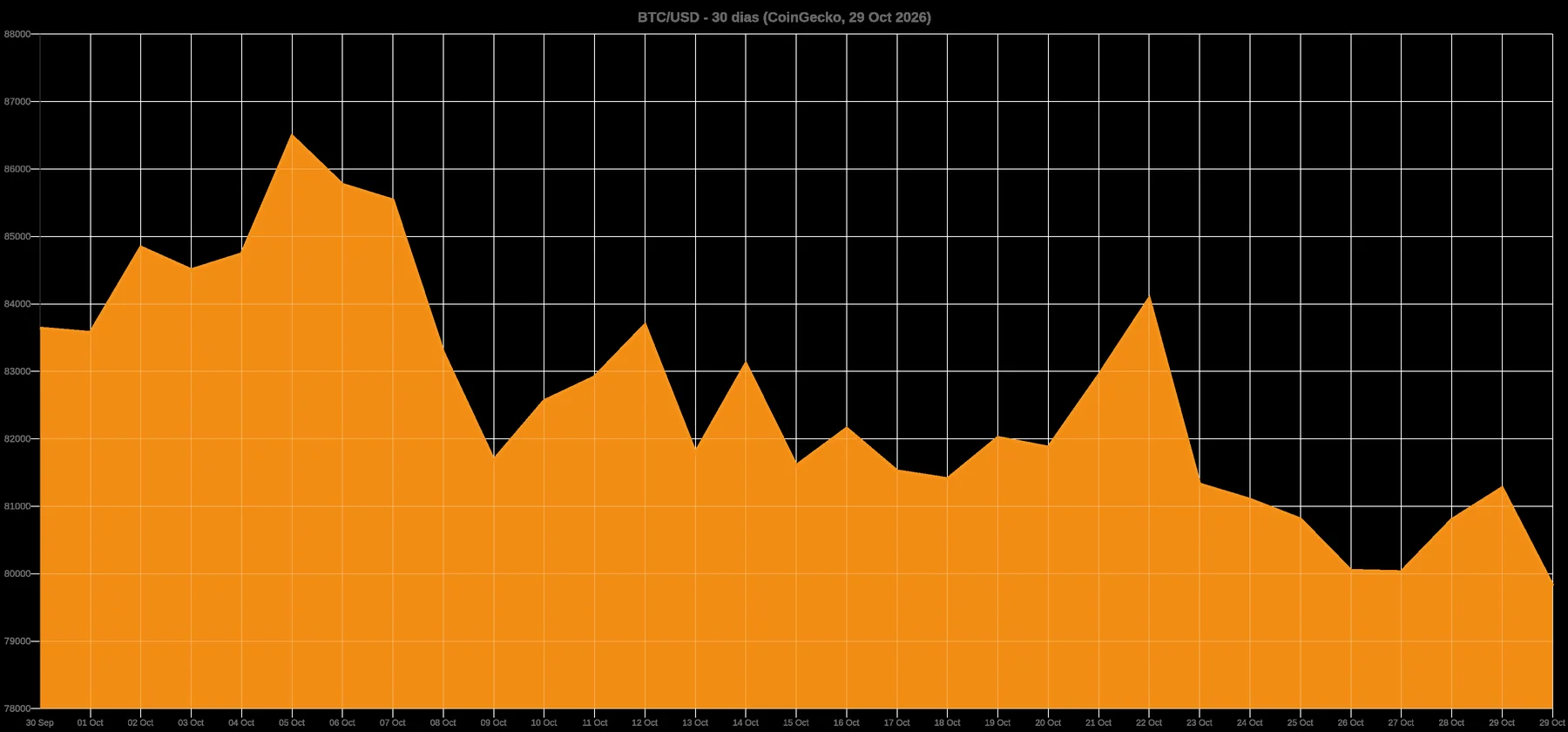
Bitcoin is the best crypto to buy now for a core position, while Zcash is the higher-risk trade with a defined, dated catalyst. Bitcoin trades near $80,000, about 36% below its October 2025 record of $126,080, and Zcash has moved into the market’s top ten with a roughly $21 billion capitalization. Both assets are being repriced this week around one policy decision: the Federal Reserve’s October 28 vote to hold its benchmark rate at 3-3/4 to 4 percent, with two officials dissenting in favor of another increase. Bitcoin dipped below $80,000 on the statement before recovering, and Zcash gave back part of a months-long climb. The next major input is the September personal-consumption-expenditures report, the Federal Reserve’s preferred inflation gauge.
What the FOMC’s 10–2 Hold Means for Bitcoin
The Federal Open Market Committee left the federal funds target range unchanged at 3-3/4 to 4 percent, the range it has held since a quarter-point increase in September. In the statement released at 2:00 p.m. Eastern on October 28 , the committee said it “decided to maintain the target range for the federal funds rate at 3-3/4 to 4 percent, in support of the Federal Reserve’s dual mandate.”
The result was not unanimous. “Voting against the monetary policy action were Lisa D. Cook and Beth M. Hammack, who preferred to raise the target range for the federal funds rate by 1/4 percentage point at this meeting,” the statement read. A 10–2 hold is a hawkish hold, not a dovish one: two of the twelve voting members are already on record in favor of tightening, which keeps a December increase on the table.
On inflation the committee was direct: “Inflation remains elevated.” That line matters for Bitcoin because it keeps restrictive monetary conditions alive, and non-yielding assets compete against Treasury yields for capital when the rate path points higher rather than lower. Bitcoin fell to an intraday low of $79,636 after the decision before recovering to about $80,042, down 1.6% over 24 hours, per CoinGecko . Ether fell about 2.1% to $2,315. BlockchainReporter laid out the December test for Bitcoin after the decision in its coverage of the Fed’s hold .
Zcash’s Quantum-Resistance Roadmap Keeps It in the Top Ten
Zcash is the coin to watch in the speculative half of a best-crypto list. ZEC trades near $1,247, down about 5.2% over 24 hours but up 0.8% over the week, with a market capitalization near $21.2 billion — good enough for the tenth spot in the crypto rankings, per CoinGecko. Its 21-million supply cap is the same as Bitcoin’s, and roughly 17.01 million ZEC are already circulating. The all-time high of $3,191.93 was set October 28, 2016, ten years to the day before this week’s Fed decision.
The catalyst is structural rather than a single announcement. Zcash activated its Ironwood shielded pool on July 28, 2026, introducing note formats designed to keep funds recoverable if current cryptography is later broken by a quantum computer. The governing specification, ZIP 2005 (“Ironwood Quantum Recoverability”), remains in “Proposed” status, and its authors are careful about what it does not do. “This change does not by itself make Zcash secure against attacks using quantum computers, but is a necessary and substantial step toward that goal,” the ZIP states .
On October 18, the Zcash node-software team Zakura published a follow-up proposal for post-quantum unlinkable swaps, aimed at a specific weakness in cross-chain trades through NEAR Intents. “Until Tachyon ships, there is a glaring hole: a single published shielded address lets a quantum attacker link every payment that address’s key has ever received,” the post reads . The team frames the fix as something wallets can adopt quickly: “We set out to build a fix that wallets can deploy today.” BlockchainReporter has tracked Zcash’s quantum-resistant payments timeline separately.
The Math Behind the Two Trades
A 2x on Bitcoin is not the same as a 2x on Zcash, and the difference is the market capitalization each would require. Bitcoin’s market cap is roughly $1.61 trillion at $80,042, so a double to $160,000 would mean adding about $1.6 trillion of new value — a move that depends on a wave of new capital rather than a catalyst alone.
Zcash’s path is arithmetically easier. At $1,247 with 17.01 million coins in circulation, ZEC’s market cap is about $21.2 billion. To match Solana’s current $59 billion capitalization, ZEC would need to reach roughly $3,468 — a 2.8x from here. To match BNB’s $98 billion, it would need about $5,760, a 4.6x. A 10x to $12,476 would lift Zcash’s market cap near $212 billion, above every asset except Bitcoin and Ether. These are arithmetic ceilings, not forecasts; whether any of them happens depends on the quantum narrative holding.
Put in dollar terms: $1,000 in ZEC at $1,247 buys about 0.80 ZEC, worth roughly $2,780 if Zcash reaches Solana’s market cap. The same $1,000 in Bitcoin buys about 0.0125 BTC, worth $2,000 only if Bitcoin doubles.
The Skeptical Case for Both Assets
The clearest risk to Bitcoin this week is policy, not chain fundamentals. If the September PCE report prints hot, the December dissent could become a majority, and the two officials who wanted a hike Wednesday are already on record. If inflation cools instead, the higher-for-longer pressure on Bitcoin eases and the $80,000 floor has a better chance of holding.
For Zcash, the risk is that quantum resistance remains a story rather than a product. The Ironwood pool is live, but ZIP 2005 is still proposed, and the Zakura swap fix is a wallet-level proposal that has not yet been adopted by major wallets. ZEC’s 5.2% daily decline on October 29, against a 0.8% weekly gain, shows how quickly the trade can give back. Privacy assets also carry a standing regulatory risk that Bitcoin does not, which is worth weighing before sizing a position.
Frequently Asked Questions
For a core position, Bitcoin is the lower-risk choice at roughly $80,042 — about 36% below its October 2025 record — while Zcash is the higher-risk trade with a defined quantum-resistance catalyst. Neither is a certainty, and position size should reflect the gap between the two.
Bitcoin dipped to an intraday low of $79,636 after the Federal Reserve held rates at 3.75–4% on October 28 on a 10–2 vote, with two officials dissenting in favor of a hike. The statement warned that “inflation remains elevated,” keeping restrictive monetary conditions on the table. BTC has since recovered to near $80,000.
ZEC traded near $1,247 at the 09:37 UTC print on October 29, down 5.2% over 24 hours, with a market capitalization of about $21.2 billion and a top-ten ranking, per CoinGecko.
No. Zcash’s Ironwood shielded pool, activated July 28, 2026, is designed to make funds recoverable if cryptography is later broken, and ZIP 2005 remains in “Proposed” status. The network is taking steps toward quantum resistance, but its shielded transactions are not yet post-quantum secure.
Two FOMC members — Lisa Cook and Beth Hammack — already dissented in favor of a quarter-point increase in October. A hot September PCE report would strengthen the case for a December hike, while cooler inflation would weaken it. The committee has not committed to either path.
Disclosure: This article does not represent investment advice. The content and materials featured on this page are for educational purposes only.