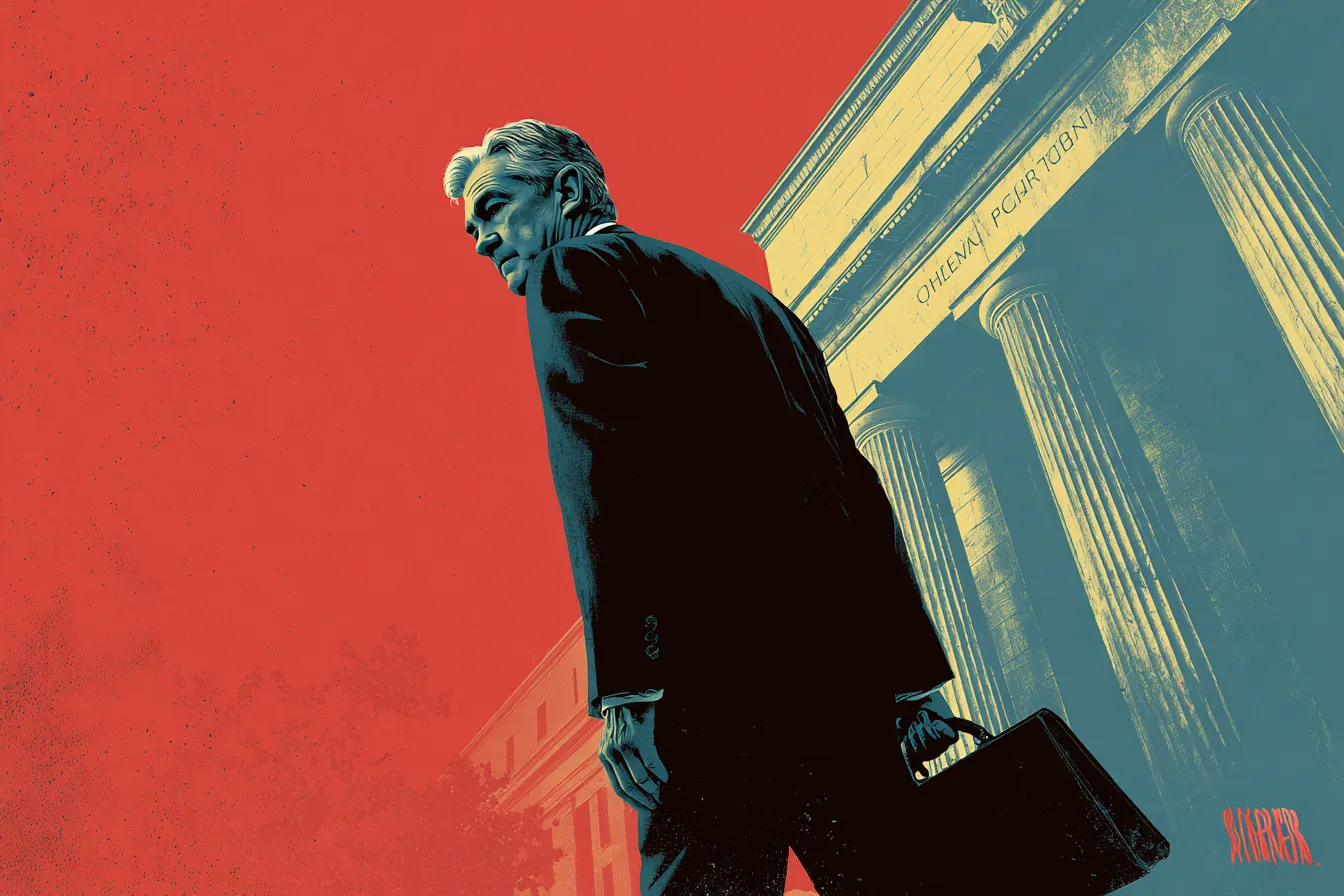
Outgoing US Federal Reserve Chief Jerome Powell during his final press conference on Wednesday rocked the boat for cryptos.
He and a majority of Fed policymakers steered a bit on the hawkish side given the lack of progress in the Gulf. Also, at his swan song meeting, Powell carried an anti-Trump crescendo, hitting out at the US administration's legal attacks.
Following the Fed's most divided since 1992 decision of holding rates steady, Bitcoin lost recent momentum and extended its slide for the third straight session.
Cryptos remained under pressure through Powell's final presser.
Dissent Amid War Uncertainty
The US central bank held rates steady for their third consecutive meeting, despite Trump's rhetoric in favor of steep rate cuts.
Since October 1992, no decision has been as divided as Wednesday's 8-4 vote to hold rates steady for their third consecutive meeting, despite Trump's rhetoric in favor of fast and steep rate cuts.
Following a crucial vote in the Senate Committee, Fed pick Kevin Warsh was confirmed to become the next boss.
So Fed rate cuts could be back in play as Trump has repeatedly asked for.
But when it comes to lowering rates, Warsh faces a tough inflation environment.
There was dissent on the decision to pause rates from four Fed policymakers. That's the first time so many policymakers have voted against a common decision since 1992.
The dissents went in opposite directions.
Once again, Fed Dove Stephen Miran voted in favor of a 0.25% rate cut.
On the other hand, Lorie Logan, Elizabeth Morgan Hammack, and Neel Kashkari were against included the phrase "easing bias" in the official statement.
Policymaking were worried that the latest developments in the Iranian war were adding to the "high level of uncertainty." The statement highlighted the issue of rising energy prices, with officials preparing for higher inflation.
The division within policymakers suggests a tougher two-way debate on rates at Kevin Warsh’s first FOMC meeting as Chair in June. Opponents of Warsh's communication say it shows a willingness to break from the consensus-driven approach seen under previous leadership, which they say has led to a group mentality that has made it hard to respond quickly to new events.
In June, Warsh needs to succeed in creating an environment that encourages open dialogue and respects different points of view.
This points to the possibility of unforeseen events, which might cause the market to experience further volatility.
It is anticipated that tensions between the President and a more aggressively positioned Fed would persist due to Powell's announcement that he will continue serving as governor for an extended length of time, with his tenure ending in January 2028.
No Respite for Cryptos From the Iran War
Trump maintained the US blockade of the key strait of Hormuz in place after rejecting Iran's offer on Wednesday.
Fuel and airline prices have risen as a result of the historic energy shock caused by the Iran war disruption to trade flows. US inflation is poised to rise back to 4%, double the Fed's target rate.
But the Fed downplayed the current price spike, calling it a temporary supply shock rather than demand-driven inflation.
Supply disruptions are now smaller, and household real incomes are already under pressure, unlike during the pandemic. This lowers the likelihood of a second-round inflation effect. Still, the Fed is no longer anticipated to cut interest rates in 2026, according to Polymarket bets.
The probability of a rate cut by the US central bank this year hit a record low of 44% on Polymarket.
Following the FOMC meeting and Powell's final presser, Bitcoin hit an intraday low of $74,937, just below the 20-day simple moving average of $75,664, which traders viewed as critical for confirming the support-resistance flip.
According to TradingView, once Bitcoin breaks out over the daily chart's channel resistance, it will need to close each candle above the trendline on a continuous basis. Then, it will likely revisit lower support between $76,500 and $75,500.
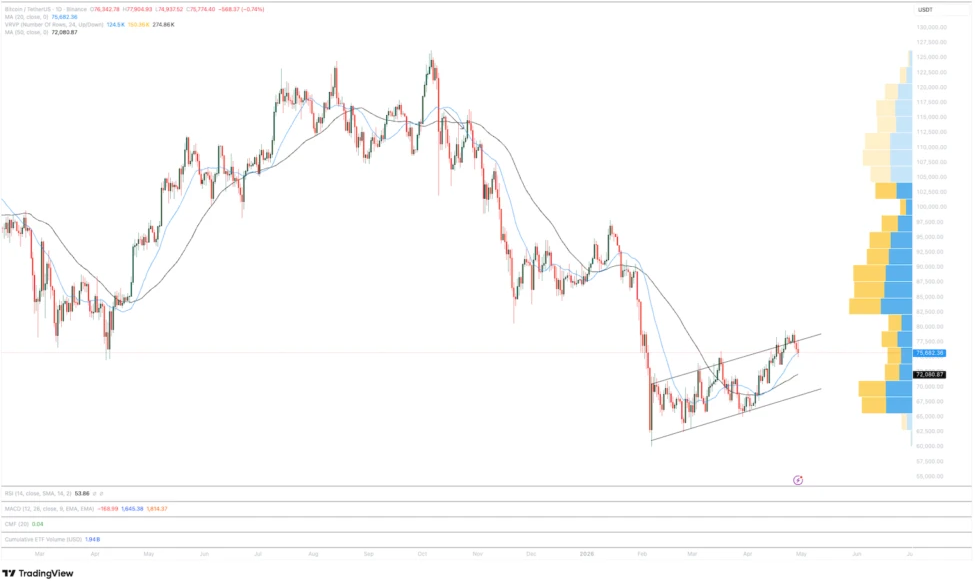
Bitcoin could still test the bottom of the almost four-month-old channel if it fails to close above the trendline resistance and reclaim the 20-MA.
Bitcoin spot volumes across major exchanges have fallen to their lowest levels since October 2023.
— glassnode (@glassnode) April 29, 2026
Such low volume environments often coincide with reduced market depth and heightened sensitivity to flow shifts
? https://t.co/XLo1nlsykP pic.twitter.com/Pn6xfZs4gx
According to Glassnode's analysis, Bitcoin traders were boosting their negative leverage just before Powell's speech.
The authors cited a divergence between the cumulative volume differential of the spot and futures markets, a spike in open interest following Tuesday's climb to $79,000, financing remaining neutral, and other indicators.
Heading into today’s FOMC decision (2pm ET), BTC traders are adding leverage with a bearish tilt.
— glassnode (@glassnode) April 29, 2026
- OI rising since yesterday’s $79k retest
- Funding predominantly below neutral
- Spot & Futures CVD diverging, with futures driving selling pressure
? https://t.co/x9iv51aY6b pic.twitter.com/0EtRUIvGza
Further insights from Glassnode’s The Week Onchain report illustrate Bitcoin’s price movement as “constrained beneath market average," with $65,000 to $70,000 serving as support, yet sluggish demand hinders the development of lasting upward trends.
The report indicates that Bitcoin was unable to surpass its True Market Mean of $79,000.
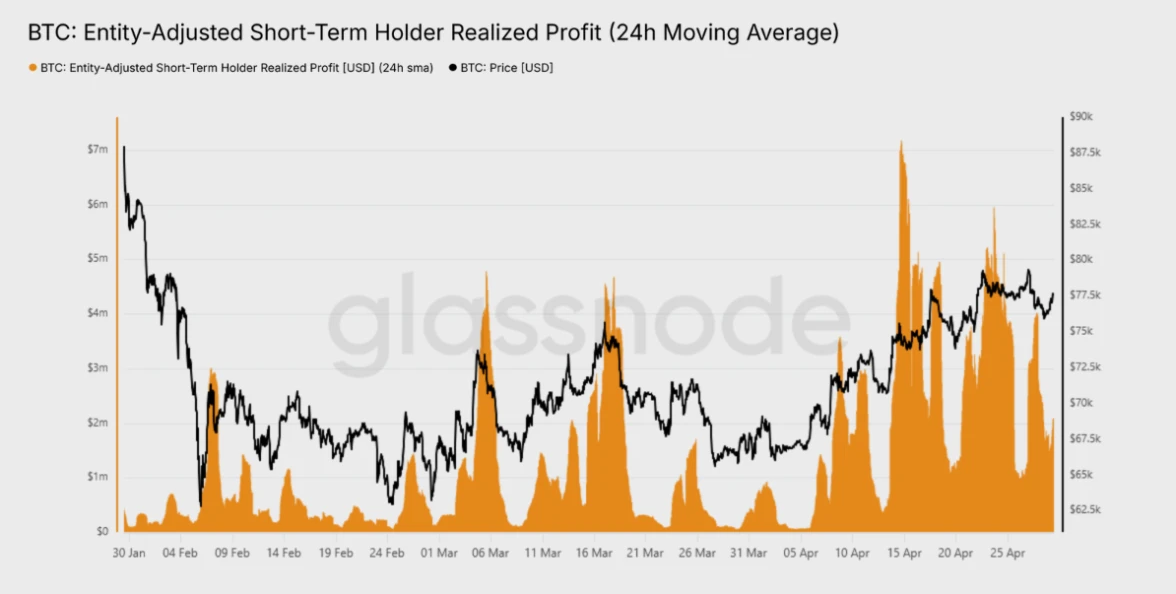
Additionally, a rise in profit-taking among short-term holders, coupled with margin futures shifting to a net short position, has diminished Bitcoin's bullish momentum in the near term.
More Downside?
The price of Bitcoin was unable to maintain its position above the $76,500 support level.
BTC has continued to struggle, falling further into a bearish trend and dropping below the $76,000 mark.
It also declined beneath the $75,00 mark.
TradingView data shows the price reached a low of $74,940 and is currently in a phase of consolidating its losses.
A slight uptick was observed beyond the 23.6% Fibonacci retracement level of the decline from the $77,888 peak to the $74,940 trough.
Currently, the price of Bitcoin is below $76,500, which is also below the 100-hour simple moving average. It may start a fresh rising trend if the price stays above $75,000.
Around the $76,400 level, which is also the 50% Fibonacci retracement level from the slide that began at the $77,888 peak and went all the way to the $74,940 trough, is where the present resistance is located.
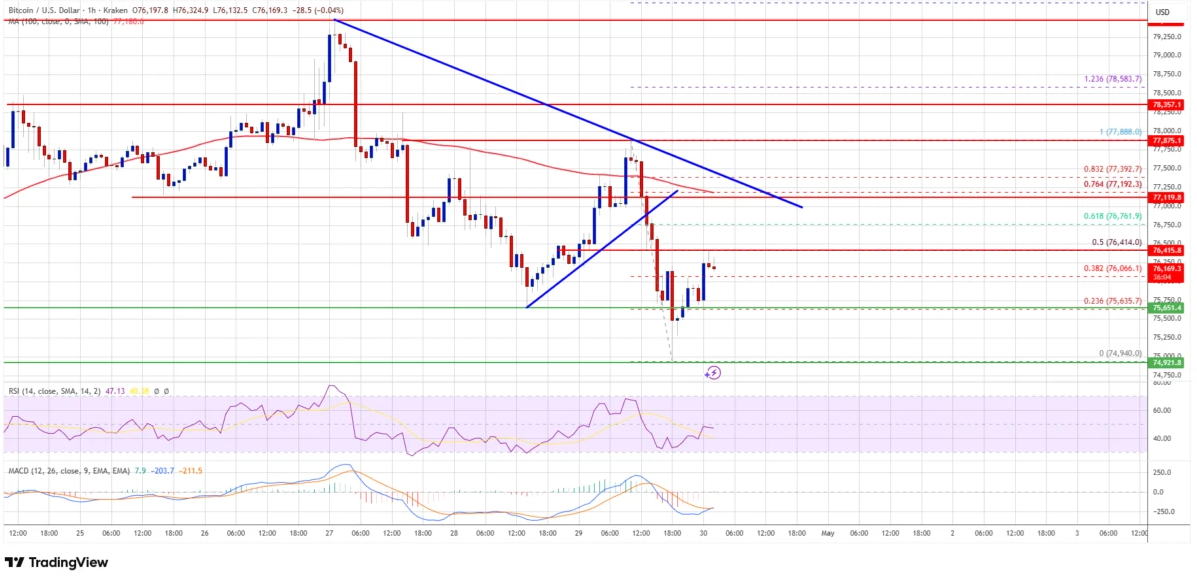
Around the $77,200 mark is when you'll encounter the first major obstacle.
The hourly chart for the BTC/USD pair shows the emergence of a negative trend line, which presents resistance at $77,200.
Price escalation is possible if the $77,200 resistance level is broken.
If this plays out, we might see the price rise towards the $77,650 level of resistance. If prices continue to rise, they may reach $78,000.
Perhaps $78,500 will be the next obstacle for the hopeful investors.
Further declines might be in store for Bitcoin if it is unable to break through the $77,200 barrier mark.
Around the $75,500 mark, there is immediate support.
Further declines could push the price down to the $74,200 support level in the short term.
The primary level of support currently stands at $73,500; if BTC falls below this threshold, it may face challenges in regaining momentum in the short term.