

Hyperliquid is a purpose-built Layer 1 designed for high-performance trading and decentralized finance. The network runs its own matching engine and validator set, allowing it to deliver execution speeds comparable to centralized exchanges while maintaining on-chain transparency and user custody.
“Hyperliquid is a decentralized trading protocol that operates on its own Layer-1 blockchain with fully on-chain order books for spot and perpetual markets,” according to its MiCAR white paper prepared for listing. White-paper-HYPE
Unlike most DeFi protocols that rely on external infrastructure, Hyperliquid integrates its order book, execution layer, and settlement directly into its own chain. This reduces latency and enables a trading experience closer to centralized exchanges while remaining fully on-chain.
The ecosystem includes perpetual futures markets, spot trading , and an expanding set of DeFi primitives through HyperEVM. This positions Hyperliquid as a hybrid between centralized exchange performance and decentralized infrastructure.
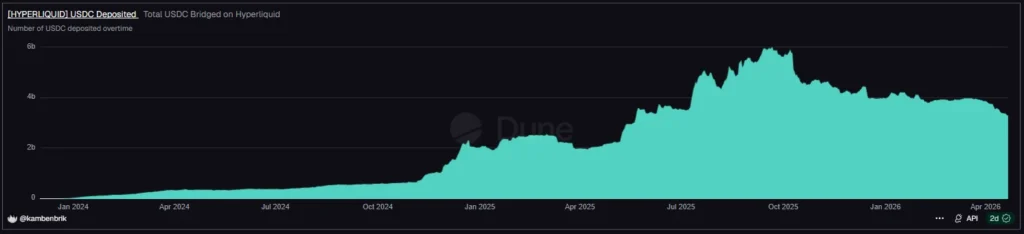
Open interest on Hyperliquid crossed $5.6B in April 2026, according to Kam Benbrik’s Dune dashboard (snapshot: April 22, 2026). Daily perpetuals volume has repeatedly exceeded $8B, placing the platform ahead of major centralized exchanges in certain sessions. These are metrics more commonly associated with large centralized venues than young on-chain trading networks.
Notably, the MiCAR white paper does not identify a formal issuer, describing Hyperliquid as a decentralized infrastructure without a single controlling entity. White-paper-HYPE
Following the Genesis Event, a substantial portion of tokens remains reserved for future distribution. This creates the foundation for a potential Season 3 and is the primary reason the farming thesis exists.
2. Why Season 3 Is a Plausible Thesis
This is not a confirmed event. It is a probability based on observable signals.
While no official roadmap confirms a Season 3, the token structure and distribution dynamics suggest that additional incentive phases remain likely.
1. Unclaimed token allocation
Public data and third-party analyses indicate that a large portion of the HYPE supply remains allocated for future emissions and community rewards . In similar ecosystems, such reserves are typically distributed over multiple phases rather than a single event.
2. HyperEVM expansion
HyperEVM launched after the Genesis Event and represents the next major growth vector. Early-stage ecosystems usually rely on incentives to attract liquidity, developers, and users.
3. Multi-phase distribution patterns
Comparable projects rarely limit themselves to a single airdrop. Instead, they run multiple campaigns tied to product releases and ecosystem growth.
4. On-chain activity imbalance
Dune data shows that daily transaction counts on HyperEVM currently hover around 60,000–70,000, significantly below peak levels seen in late 2025, when activity exceeded 500,000 transactions per day
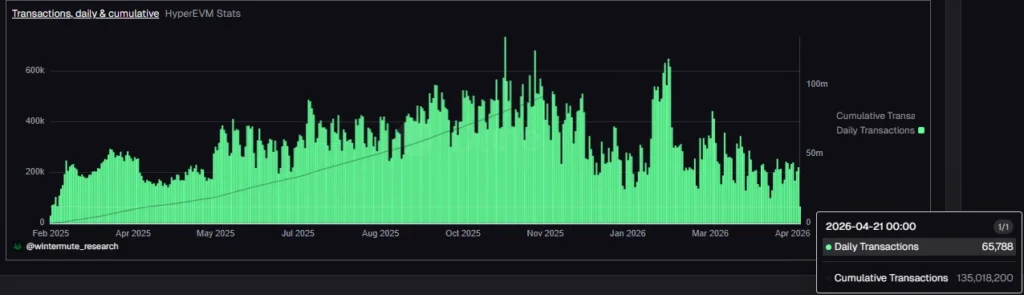
per the same Dune dashboard ( Wintermute )
5. Strategic positioning
The team has not declared the Genesis Event as final. In similar cases, this often precedes additional reward cycles.
“Over the past 2 weeks, RWA trading on Hyperliquid has repeatedly broken records, surpassing $1.3B in open interest and $1.4B in weekend volume,” the team wrote on X (March 12, 2026).
Taken together, these signals do not guarantee a Season 3 but form a reasonable probabilistic case.
3. How to Farm Season 3
The steps below reflect general behavior patterns that commonly matter in on-chain incentive campaigns. They should be understood as heuristics, not guarantees.
Specific sybil filtering criteria for Season 3 are not publicly disclosed. The guidelines below reflect patterns observed in previous incentive programs and general on-chain heuristics.
Step 1: Bridge assets
Action:
Transfer USDC or ETH via the official bridge
Cost:
$1–3
Time:
2–5 min.
Sybil note: Avoid very small transfers. A range of $50–200 is more consistent with organic usage.
Step 2: Execute perpetual trades
Action:
Open and close a small position
Cost:
Minimal
Time:
1–2 min.
Sybil note: Avoid repetitive micro-trades. Spread activity across multiple sessions.
Step 3: Provide spot liquidity
Action:
Add liquidity to pairs such as ETH/USDC
Cost:
~$0.10
Time:
~2 min.
Sybil note: Keep liquidity active over time. Instant add/remove patterns are often filtered.
Step 4: Interact with HyperEVM protocols
This is likely the highest-signal area for potential rewards.
Action: Perform swaps, lending, staking, and other contract interactions across multiple HyperEVM applications, such as:
- HyperSwap – native DEX for token swaps and liquidity provision
- HyperLend – lending market similar to Aave, allowing users to supply and borrow assets
- Kinetiq – liquid staking protocol for HYPE (kHYPE) and yield strategies
- Felix Protocol – CDP-based stablecoin system (mint feUSD and use it across DeFi)
- HyBridge – bridge assets into HyperEVM and interact with cross-chain flows
These protocols represent the core of the current HyperEVM ecosystem , spanning trading, lending, and staking use cases.
Cost: $0.05–0.20 per action
Time: 10–15 min.
Incentive programs often target underutilized layers, and current on-chain data shows that HyperEVM activity remains below previous peaks, suggesting potential upside for early users.
Sybil note: Use multiple protocols and vary interaction patterns. Repeating identical sequences across wallets increases detection risk.
Step 5: Acquire an NFT
Action:
Buy or mint a low-cost NFT
Cost:
$0.10–0.30
Time:
~3 min.
Sybil note: One NFT per wallet is sufficient. Repeated low-value mints can appear artificial.
Step 6: Participate in governance
Action:
Vote or delegate
Cost:
Minimal
Time:
~2 min.
Sybil note: Consistent engagement is more credible than random activity.
Step 7: Use social features
Action:
Follow traders or leave comments
Cost:
Free
Time:
~5 min.
Sybil note: Avoid templated comments. Natural variation matters.
Step 8: Maintain weekly activity
Action: At least one trade and one EVM interaction per week
Sybil note: Consistency over time is more effective than short bursts.
Step 9: Maintain a balance
Action: Keep $50–200 on-chain
Sybil note: Wallets with negligible balances are more likely to be excluded.
Step 10: Avoid predictable patterns
Action: Spread actions across different days and times
Sybil note: Identical timing across multiple wallets is a common filtering signal.
4. Additional Optimization Strategies
Wallets that interact across multiple layers, including trading, liquidity, and smart contracts, align more closely with how protocols measure real usage.
Instead of performing all actions in a single session, extend activity across several weeks. Time-based engagement is often used as a signal of real users.
Running multiple wallets with identical behavior significantly increases sybil risk. If multiple wallets are used, they should not share identical timing, size, or interaction patterns.
New HyperEVM projects may become key targets for incentives. Early interaction with emerging protocols can provide additional upside.
On-chain behavior that resembles real users, including irregular timing, varied interaction types, and sustained balances, is harder to classify as sybil activity.
5. Risk Rating: 3.5 / 5
Scale definition:
1 = confirmed airdrop with clear criteria
5 = fully speculative with high uncertainty
Reasons for higher risk
- No official confirmation of Season 3
- Increasing competition among farmers
- Unclear sybil filtering criteria
Reasons for lower risk
- Large undistributed token allocation
- Strong product traction
- Low transaction costs
Assessment:
This is a moderate-risk opportunity. It reflects both structural upside and uncertainty.
6. Related Airdrops
Hyperliquid’s ecosystem is expanding beyond its core trading layer. Projects building on HyperEVM or closely integrated with the protocol may also introduce incentive programs:
- Hypurr – NFT-focused project on HyperEVM. Early interaction and mint activity may be tracked for future rewards.
- Kinetiq – liquid staking protocol for HYPE (kHYPE). Staking and yield participation could be part of future incentives.
- Felix Protocol – CDP-based stablecoin system. Minting and using feUSD across DeFi may contribute to eligibility.
7. Conclusion
Hyperliquid combines centralized exchange performance with on-chain transparency, and its derivatives volume already rivals established platforms.
The case for Season 3 is based on observable factors: a large undistributed token allocation, a newly launched execution layer in HyperEVM, and clear imbalances in network activity.
At the same time, the strategy remains uncertain. There is no confirmation from the team, no published criteria, and no guarantee that current behavior will be rewarded.
Unlike short-term farming strategies, this setup favors consistent activity over time. Regular interaction across multiple parts of the ecosystem aligns more closely with real user behavior.
If Season 3 happens, it will likely reward users who engage with the ecosystem as intended, not those optimizing purely for extraction.