The post Crypto Stocks Decline Over 10% on Looming Stablecoin Yield Ban appeared first on Coinpedia Fintech News
The latest draft of the Clarity Act, a bill seeking to provide better regulatory oversight in the crypto industry, has proposed a ban on stablecoin yields, while permitting active rewards on the same.
Should this bipartisan bill get Senate approval, it would effectively ban passive interest on stablecoin deposits, but allow active rewards for using said digital currencies, even though the actual details on this remain unclear.
Possible stablecoin yield ban sends crypto stocks tumbling
The news sent shockwaves through the crypto industry, with USDC issuer Circle Internet Group Inc. and Coinbase Global Inc. feeling the most heat.
Circle stock (NYSE: CRCL) fell 21.25% in the day to trade at $99.73, with its market cap plunging from over $31 billion to $24.61 billion.
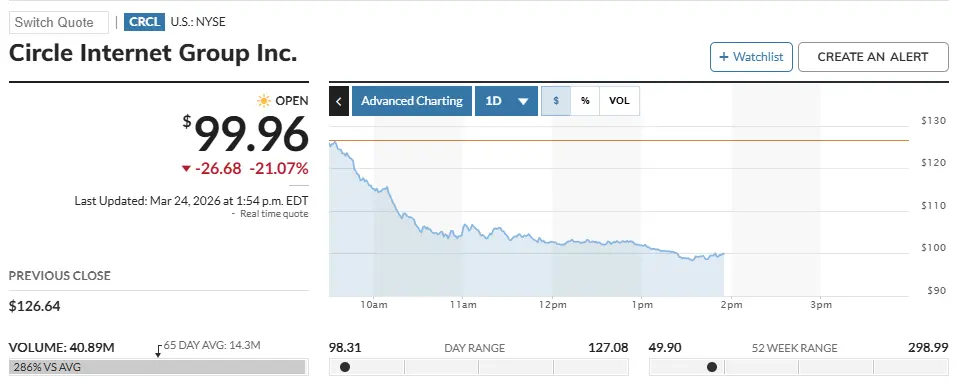
Source: MarketWatch
Meanwhile, Coinbase shares (NASDAQ: COIN) shed 11.08% in the day to trade at $178.39, with its market cap falling from $53.3 billion to $47.7 billion post news.
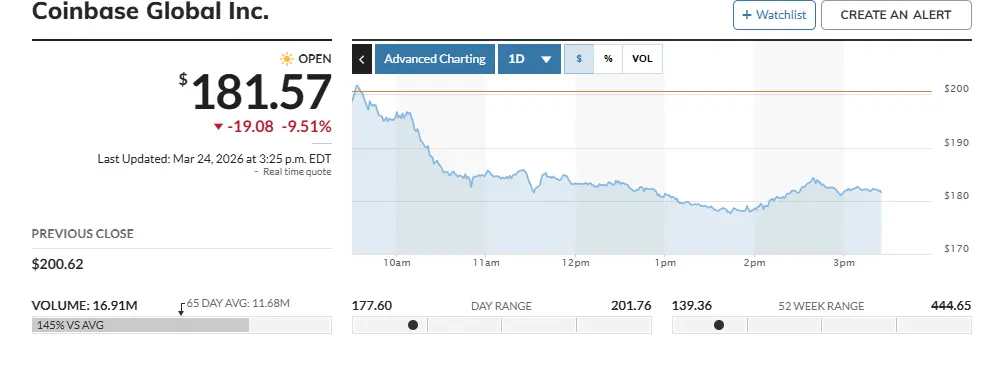
Source: MarketWatch
Coinbase CEO Brian Armstrong has previously noted that such legislation would hurt user profits on deposits, even though it would increase the company’s short-term profitability since it would have fewer rewards to pay out.
Banks, blockchain, and digital currencies
Notably, the Clarity Act has remained stalled in the Senate as banks lobby for the ban on stablecoin-based interests, reasoning that they create unfavorable competition against bank deposits.
This drew criticism from US President Donald Trump and his crypto-activist son Eric Trump, with the two arguing that banks are delaying clarity development in the crypto industry.
Just recently, former SEC Chair Gary Gensler sided with banks, saying stablecoins “undermine the banking system” and could “destabilize” the economy.
— Astik Mondal (@Astik_Mondal_) March 24, 2026
BREAKING: Former SEC Chair Gary Gensler sides with big banks against Bitcoin & crypto LIVE on CNBC
“Stablecoins can undermine the banking system… destabilize the economy”
They’re scared. We’re winning.
#Bitcoin #Crypto #Stablecoins #DeFiRevolution #FinancialFreedom pic.twitter.com/k8xhPZurQz
That said, banks have had to bow down to pressure to keep up with blockchain-based investment products. This has led many of them to adopt real-world asset tokenization to foster 24/7 trading with fewer intermediaries, shorter settlement periods, and fractional asset ownership for retail investors.
JPMorgan Chase, BNY Mellon , and Goldman Sachs are just a few among those bridging traditional finance with blockchain. Bank of Montreal (BMO) and CME Group recently announced plans to launch tokenized cash services late in 2026, pending regulatory approval.