


The cryptocurrency market staged a recovery on Monday even as the broader financial landscape came under pressure, with escalating tensions between the US and Iran — now entering their fourth week — driving volatility across oil markets and risk assets alike.
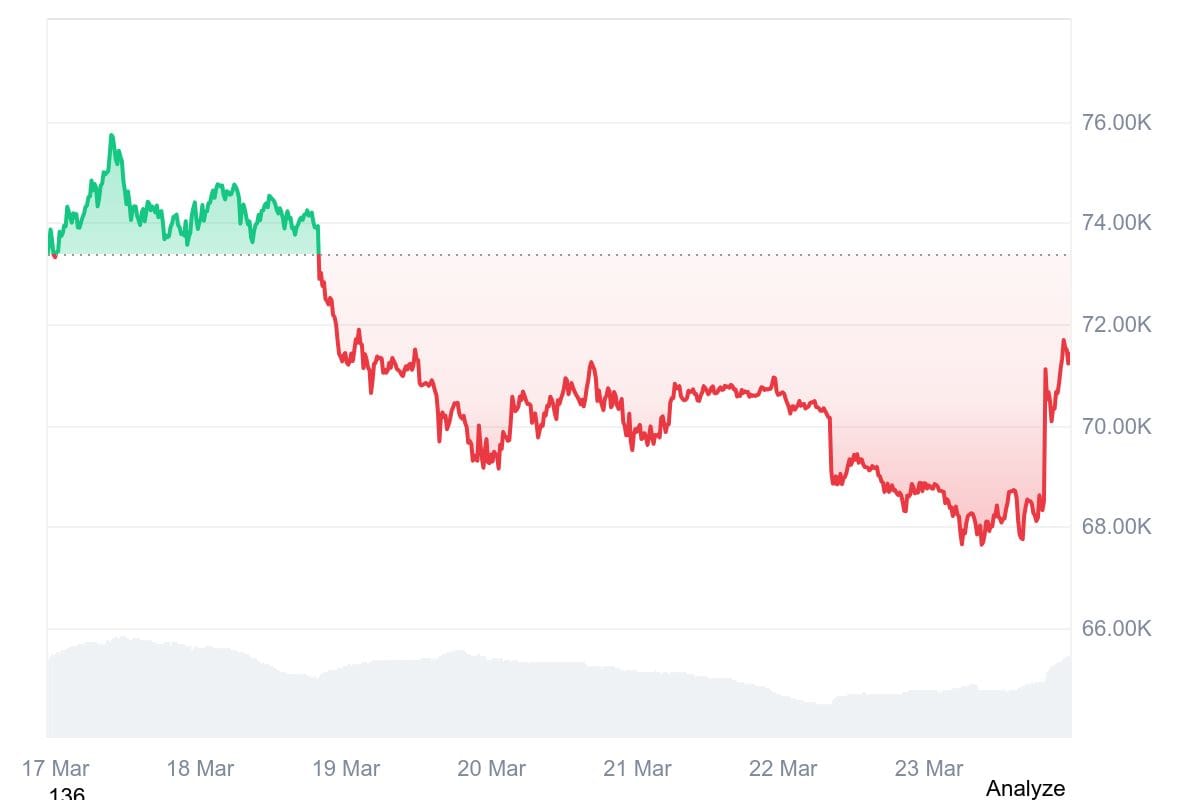
Bitcoin gained over 4% in the past 24 hours to trade at $71,500, bouncing back from a low of under $67,600 during late Sunday trading. Total crypto market capitalization rose 2.99% to $2.43 trillion. The rebound came despite a broader risk-off environment that dragged down equities across Asia and pushed crude oil prices toward triple digits.
The geopolitical backdrop remains fraught. On Sunday, US President Trump posted on Truth Social that unless Iran opens the Strait of Hormuz within 48 hours, the US will "hit and obliterate" its power plants, starting with the largest. Tehran has threatened to strike US and Israeli assets in the Gulf should Washington target its power or water infrastructure — and has floated the possibility of closing the Strait entirely, a move that would disrupt a critical artery for global oil shipments.
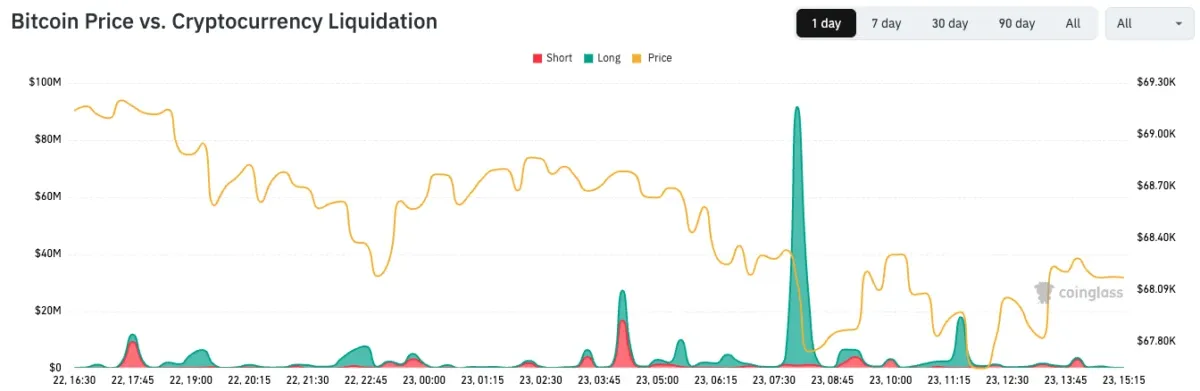
Bitcoin's advocates have long positioned it as a safe-haven asset comparable to gold, but the price action ahead of the recovery told a different story. Before clawing back gains, the asset's slide triggered $336.3 million in liquidations over 24 hours. According to CoinGlass, roughly $100 million of that — about a third — came from long positions in Bitcoin that were caught offside.
Broad-Based Retreat Across Assets
Monday saw a sea of red across asset classes, with several Asian stock markets reacting to the escalating threats.
Japan's market declined over 4%, while the benchmarks in Australia and New Zealand showed modest losses.
In the initial hours of trading on Monday, US crude oil prices climbed to just above $100 per barrel, only to quickly drop to $97.20. Since then, it has steadily risen, and currently stands at $99.30.
The price of Brent crude oil, which is used as a benchmark for international oil purchases, jumped over $114 per barrel and then settled just below $113.
Fed Bets Driving Crypto Now
For cryptos, what the Federal Reserve does is turning out to be more important from the macro angle.
The recent spike in Brent prices is impacting inflation expectations, which in turn is driving up the possibility of a rate hike by the Fed, which has gone from zero to twelve percent in the span of a week.
Until there is better comprehension on both fronts, this signifies a significant shift in the wider market, which the cryptocurrency sector will continue to reflect. Analysts say cryptocurrencies are among the most susceptible to sudden price drops in the event that tensions with Iran subside.
Nevertheless, it is difficult to make short-term forecasts regarding the outcome of this issue because there is no clear negotiation partner and no set deadline for settlement.
For Bitcoin, if $68,000 doesn't hold, then $65,800 is the next major support level for Bitcoin. It's important to keep an eye on both levels. Before any recovery narrative can be considered credible, Bitcoin has to reclaim $71,500.
This month has seen robust institutional backing for Bitcoin, highlighted by $1.43 billion in net inflows to Bitcoin exchange-traded funds.
The historical trends show that when the mood is so low and the institutional structure is strong, the conditions are there for a rebound to happen, even though when exactly that will happen is still up in the air.
Momentum Loss or a Reversal?
Over the weekend, Bitcoin's price dropped below $70,000, erasing all gains from the previous week.
This puts the cryptocurrency in a risky position, as hopeful investors must now determine if there is another substantial support level or whether the price may fall much more.
According to TradingView, if Bitcoin bulls want to start a new uptrend, the price needs to go back over $69,000 and keep the momentum going.
Barring unforeseen circumstances, the value of Bitcoin is anticipated to surge to a range of $73,000-74,000. As things stand, there's still a chance for one last surge towards the $76,000–$77,000 area.
If the bulls fail to maintain the $69,000 level, we could witness significant bearish movement in the market. This downward trend is expected to result in a decline of at least 5%, with the market expert estimating the target range to be between $64,000 and $66,000.
Although this downturn may not be as significant as earlier steep drops, it could still have adverse effects on alternative cryptocurrencies, which are already facing challenges.
The bulls were able to keep the $68,000 level, which is still quite near the objective, even if the Bitcoin price fell below that mark by Sunday.
To be sure, this puts the hopeful investors in a tough spot; they must either recoup $69,000 or wait for the trend to play out.
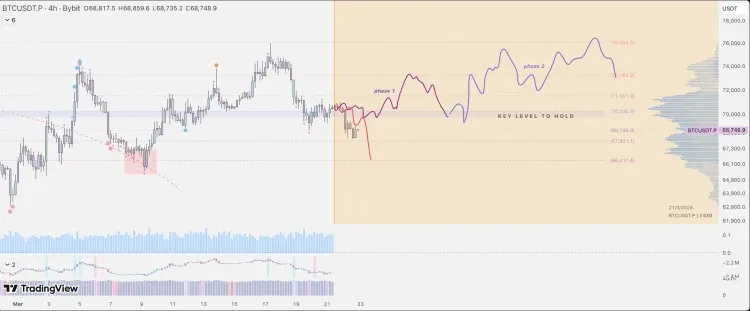
It appears that Bitcoin has entered a correction period, according to observations offered lately by crypto expert HAMED AZ. Therefore, after an initial rise toward the upper border of the ascending channel, Bitcoin's price is expected to decrease.
The negative trend is expected to continue, leading to a drop of more than 10%, unless the price manages to break through the resistance at the upper limit of the channel.
As a result, the price of Bitcoin is anticipated to go below $60,000 for the first time in over a year.
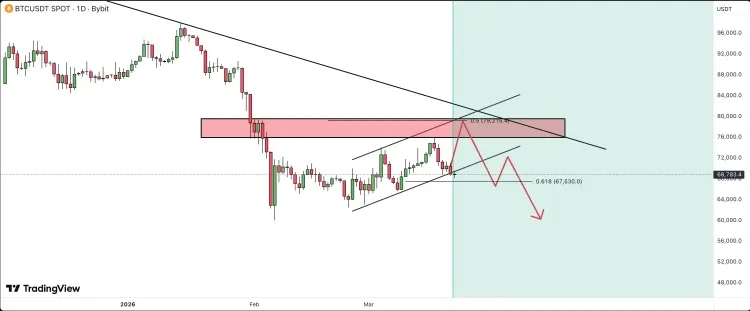
The price may indicate a full reversal of the downtrend if it successfully tests and surpasses the channel barrier with robust momentum, though. We might reach $80,000 and start the next boom if this continues.
Be at the heart of TradFi–DeFi collaboration at Money20/20 Asia 2026 .
Are you looking to forge partnerships with banks and fintechs? To expand into new markets across Asia, or to secure funding from top-tier investors? This April, the world of digital assets, blockchain, and Web3 converges with the biggest players in APAC’s financial ecosystem at Money20/20 Asia 2026 and its brand new ‘Intersection’ zone, complete with a dedicated content stage, TradFi-Defi innovator showcase, and curated networking spaces. From traditional banking giants to decentralised innovators, private equity leaders, and cutting-edge fintech disruptors, this is where they meet to forge partnerships, spark dialogue, and shape the future of finance.